Does a codebase built by agents lose coherence as it grows, and is that what makes later work harder?
Partly yes, and version 1 of this paper got the second half wrong. Harbour's code did not get textually messier as it grew: duplicated text fell from 2.5% of production lines in May to 1.2% in October while the code grew four and a half times. What grew is the number of places that hold one small decision: a tolerant timestamp parse went from one file to eighteen, the page-shell option bag from one to fourteen, and 33 decisions carry a comment admitting a second copy kept in sync by hand, of which a blind second reading confirms 25 live, four partly and four not. Version 1 said that stock was not what made later work harder, because the record showed no decline for it to explain. That sentence was inherited from the steady-base papers, which attributed the fall from 95 to 47 correct changes a week to the process around the change, and it was never tested. Tested now, with six measures named before any was computed (coherence-as-it-grows-sources/round2-preregistration.md), the twin classification read blind by a second reader, and the escapes and send-backs coded by readers who had not seen version 1: 86 of the 190 escaped defects on record (45%) have an unreconciled decision as their cause, a sibling left behind when one copy was fixed (42), a change that landed in fewer places than it needed (27), two copies that had drifted apart (12), the wrong one of several paths (3) or a stale copy of a fact (2); among faults found by use rather than by a later sweep it is 30 of 110 (27%), between 27% and 32% in every month since June. 143 of the 397 review send-backs since June (36%) name a sibling not updated, an existing path not used or a divergence; plan review finds it in 46% of its send-backs, and the share rose from 22% in July to 47% in October. A change that touches a site of a known multi-site decision, 15% of PRs, is five times the size of one that does not and is sent back two and a half times as often, and it is sent back more often within every size band. The reliability paper's finding that quality held, 5.4 then 5.7 escapes per 100 PRs, stands only after setting aside the rows a later review found, and of the August and September rows this paper marks as found later, 72% are coherence faults. So the cost of a decision held in several places is paid, and paid where the hypothesis says: in the change that has to find every site, in the gate that sends it back when it does not, and in the sibling a sweep finds later. What the record cannot show is a trend in the cost of a same-sized change, because working hours exist only from September, and the series that reach back do not rise, the coherence share of use-found faults is flat and the size of the median change moves without direction; the series that rise, the coherence share of all send-backs and of all escapes, rise as the reviews and sweeps began to look. Harbour's ways of paying the stock down have mostly not worked: a review that files has filed tickets nobody worked since June; parity tests preserve the twin; helper extractions half-finish; deletion finishes. The remedy the evidence points to is structural first, a shared pure module the browser can load and a layering rule with a place for shared predicates, and then the ticket's definition of done narrowed to the decisions a change touches, tested as the last section sets out.
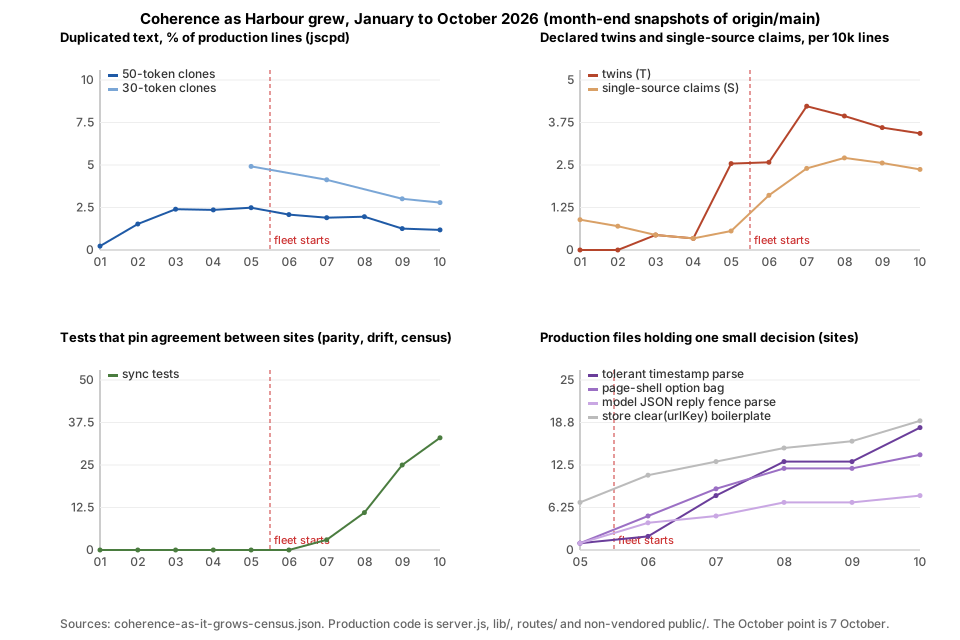
Findings
1. The code did not get textually messier as it grew; it got tidier
Duplicated text fell from 2.5% of production lines in May to 1.2% in October, while the code grew 4.5×.
jscpd over the production code at each month-end snapshot, counting any run of 50 or more tokens that appears twice:
| Month end | Production lines | Duplicated text (50-token clones) | Same at 30 tokens | Cross-file clone pairs | Pairs per 10k lines |
|---|---|---|---|---|---|
| Jan | 11,226 | 0.2% | – | 0 | 0 |
| Mar | 22,760 | 2.4% | – | 12 | 5.3 |
| May | 35,468 | 2.5% | 4.9% | 24 | 6.8 |
| Jun | 61,992 | 2.1% | – | 43 | 6.9 |
| Jul | 87,484 | 1.9% | 4.1% | 58 | 6.6 |
| Aug | 114,213 | 2.0% | – | 76 | 6.7 |
| Sep | 144,607 | 1.3% | 3.0% | 60 | 4.1 |
| Oct 7 | 160,384 | 1.2% | 2.8% | 61 | 3.8 |
The fleet started in June. Duplicated text peaked before it, in the prototyping months, and has fallen since, under both thresholds. Cross-file clone pairs grew in number until August and then fell while the code kept growing. The agents do not copy and paste. Of the 61 cross-file clone pairs at HEAD, read one by one, 24 are store scaffolding (the same clear(urlKey) or list(urlKey) method in a dozen Mongo-backed stores), 10 are one feature cloned from a sibling (brief from recap; the create and edit forms), and 27 encode a rule a later change would have to find twice: a tolerant timestamp parse (five pairs), the parse of a model's JSON reply with its code fence stripped (four), the option bag every page route passes to the shell (four), duration formatting, an in-progress de-duplication rule. On the measure the outside literature uses most for "AI code is messier", GitClear's duplication and churn series [GC25], Harbour moved the other way.
2. What grew is the number of places that hold one small decision
Eleven named decisions went from one or two sites to as many as eighteen, roughly one new site for every new module. Counting the production files that contain each decision's signature at six snapshots:
| Decision | May | Jun | Jul | Aug | Sep | Oct 7 |
|---|---|---|---|---|---|---|
Tolerant timestamp parse (toMillis, toMs, _epoch) |
1 | 2 | 8 | 13 | 13 | 18 |
| Page-shell option bag passed by a route | 1 | 5 | 9 | 12 | 12 | 14 |
| Parse of a model's JSON reply, fence stripped | 1 | 4 | 5 | 7 | 7 | 8 |
Bookkeeping stamp classifier (decision-withdrawal-reversed) |
0 | 0 | 0 | 0 | 7 | 8 |
Session classification (isStandaloneSession, isTerminalLoop) |
0 | 1 | 3 | 3 | 5 | 6 |
Review ledger heading (What CI Did Not Prove) |
0 | 4 | 5 | 5 | 5 | 6 |
Terminal-state literal ['completed','canceled','duplicate'] |
4 | 4 | 4 | 4 | 5 | 5 |
| Duration formatting | 0 | 0 | 1 | 2 | 3 | 4 |
Store clear(urlKey) boilerplate |
7 | 11 | 13 | 15 | 16 | 19 |
| Ship layout primitives, server and browser | 4 | 4 | 4 | 4 | 4 | 4 |
| Swim-lane segment rank, server and browser | 2 | 2 | 2 | 2 | 2 | 2 |
| Production files | 94 | 171 | 231 | 291 | 347 | 398 |
The decisions that grew are the ones a new module needs on its first day: how to read a timestamp that may be a Date, a string or garbage; how to read a model's answer; what the page shell needs. Each new module wrote its own. None of these eighteen timestamp parsers carries a comment that names another; they were not copied, they were re-derived. The two decisions that did not grow are the ones that were already duplicated across the server and browser in May and have had no new runtime to spread to. The Drift & Coherence review's own hand counts say the same of the decisions it tracks: the hand-rolled workspace lookup went from 4 sites in June to 16 in August and 17 in September, and the inline error envelope from 76 to 87 sites between its last two editions, all 11 new ones in code written in that window (docs/reviews/drift-coherence-review-2026-09-26.md:59-73, 94-103).
Thirty-three decisions carry a comment admitting a second copy that must be kept in sync by hand. A census of production comments that name a second site for the same rule, list, constant or algorithm, read and classed one by one (Method), finds 126 such lines at HEAD in 68 files: 55 declare a live twin, 38 declare the opposite (that this site is now the single source), 6 describe a copy that has since been removed, 5 are promises that behaviour stays byte-identical across a change, and 22 are something else (data copied at run time, an analogy). The 55 twin lines describe 33 distinct decisions. They were first declared at 4 to 9 a month through the fleet era (June 4, July 9, August 4, September 9, three in October's first week), so the rate has not fallen. Per 10,000 production lines, declared twins peaked in July at 4.2 and were 3.4 in October; single-source claims rose from 0.6 in May to 2.4, so the fleet era declares consolidations at a higher rate than it declares twins. In October the codebase also carried 33 unit-test files whose name says they pin agreement between sites (parity, drift, census, single-source); there were none before July.
Most declared twins exist because a rule forbade the import, not because the agent missed the original. The comment on each twin says why it exists:
| Stated reason | Twins | Example |
|---|---|---|
| The server and the browser cannot share a module | 11 | public/swim.js:27-31: "duplicated because the no build step constraint (CLAUDE.md) prevents importing from lib/. Keep in sync; unifying client+server is a candidate follow-up under LIN-174" |
| A layering or purity rule (a lib module must not import a route, must stay a leaf) | 4 | lib/run-view.js:267-272 (2 October): "Same rule as routes/dashboard.js's isStandaloneSession … Inlined here (rather than importing the route) to keep this module pure" |
| Code and a human document must match | 2 | the autopilot kickoff and docs/autopilot-kickoff.md |
| A data mirror kept for older readers | 2 | the binding's credentials and the legacy scalar mirror (LIN-562); the connection record and its row mirror, which served the stale token in the 3 October incident (lib/connection-credential.js:595-603) |
| Two repositories or systems | 2 | the model preset list, "hand-mirrored across repositories. Update both" (lib/render-settings.js:116-121) |
| A declared list kept beside the thing it describes, in one module | 5 | PROVIDER_SURFACE beside the provider methods; two interval constants that "MUST stay the same value" |
| A plain convenience copy where an import was possible | 7 | "Copied verbatim from lib/live-console.js's _epoch" |
Twenty-one of the 33 name a boundary or a rule, on the author's reading. A second reader given the classes and not the codes (coherence-as-it-grows-second-reading.json) confirms 25 of the 33 as live twins at HEAD, four as partly so (a three-line idiom, a pair whose regexes already differ, an adapted popover, a list half shared by import) and four as not code-against-code at all (two runtime data mirrors, two lists meant to differ, one constant that was never two); and puts 17 of the 33 on a rule or boundary, separating a stated rule (7) from an unstated runtime boundary (10), with 10 plain convenience copies, 3 intended differences, 2 compatibility mirrors and 1 unclear. On the 126 lines the two readers agree on 113 (κ 0.85).
The largest single producer on either reading is a line in the project's first commit (a82b8758, 4 January), CLAUDE.md:43: Keep it minimal - no frameworks, no build step.
Read as "no shared module between server and browser", that line has produced eleven twins, six of them before the fleet existed (the swim-lanes prototype of 16 March and the radial Ship view of 16 May). Browsers load ES modules without a build step, so the rule does not require the copies; the reading of it does. The copy in public/swim.js has pointed at LIN-174 as the place its unification would be filed since 7 June; LIN-174 closed on 10 June with no such child. The 2 October twin was made the day before the October authority rules landed, by an agent that found the original, named it, and declined to import it for a reason of its own.
Followed one by one, four of these decisions show the same life: a private copy at birth, a new copy with each new module, a helper that the callers do not adopt, and a pin that gets dodged. lineage.py walks every first-parent commit of main for four decisions and reads the tickets that name them (coherence-as-it-grows-lineage.json; narratives in coherence-as-it-grows-sources/lineage.md):
| Decision | Born | Sites, May to 7 October | PRs touching a site since June (touching all) | Fixes and complaints naming it | The helper, and what happened to the copies |
|---|---|---|---|---|---|
| Tolerant timestamp parse | 29 May (d433a2ba), a private toMillis in the report-history store |
1 / 2 / 8 / 13 / 13 / 18 | 9 (0) | LIN-2358: NaN is not null, so a branch always ran |
none ever proposed; three spellings, none exported |
| Page-shell option bag, in routes | 13 June (2b7ad939, LIN-450) |
0 / 4 / 9 / 12 / 12 / 14 | 28 (1) | LIN-1385 and LIN-1388: five doc comments still said Heroku after the Railway move, caught by plan review | getDeployInfo moved into lib/deploy-info.js on 17 July; all nine route copies kept the literal |
| Hand-rolled workspace lookup | 20 January (71395df9), a direct push on the day the canonical helper landed (LIN-100) |
6 / 9 / 15 / 17 / 17 / 19 | 42 (0) | five review editions; LIN-2389, "change the helper's shape", never landed | a count pin at 16 (LIN-3124, 29 September) was dodged twice by renaming the variable; 19 at HEAD |
| Inline error envelope | 11 January (4d9150d6) |
306 / 61 / 74 / 82 / 89 / 93 | 118 (0) | LIN-417, LIN-420, LIN-1158, LIN-2363, three send-backs, five review editions | lib/errors.js from 18 January; LIN-420 swept 357 sites to 53 on 18 June; 40 new inline sites since, mostly in files that import the helper |
The one sweep that finished, LIN-420, deleted 304 sites in a day. Everything since is accretion in new files, by agents that in three of the four cases could see the helper, and in one case named the pin they were stepping around.
3. The duplicated decisions are an obligation paid in escapes, in send-backs and in the size of the change
For the prompt rules, 84% of changes to the stage definitions also had to change the meta-prompt, until LIN-3300 deleted the second path. Of the 63 merged PRs from June to 7 October that touched lib/prompt-template-defs.js, 53 also touched lib/prompts/meta-prompt-template.js (June 18 of 20, July 8 of 11, August 12 of 13, September 10 of 12). That is the "must update BOTH" rule steady-base.md found written into the architecture doc, measured as what it made every change do. On 4 and 5 October (19d7198a, PRs #1751 and #1752) the meta-prompt path was deleted: the 106 KB meta-prompt is gone, the stage definitions shrank from 132 KB to 110 KB, and an 8 KB selector took its place. There is now one place to change a stage's rules, by construction rather than by discipline. The same kind of count for the Observation page: of the 50 PRs that touched the browser script public/observation.js, 25 also touched the server route routes/dashboard.js, which holds the session banner's "waiting for a person" derivation the first paper named and whose data the script renders.
Four in a hundred merged PRs added the same lines to two production files at once. A detector over every merged PR since January finds 70 of 1,686 (4.2%) that added three or more identical, non-trivial lines to two production files in the same change: the same isAiNotConfigured function in the brief and recap scripts, the same OAuth viewer lookup in the two GitHub auth routes (20 lines), the same layout step in lib/ship-layout.js and public/ship.js. Not every hit is a divergence in the making; the LIN-1084 PR appears because it wrote the same call to its new shared validator at both dispatch entrances, which is convergence. The rate by month runs 1.5–12% with no trend (June 2.8%, July 5.1%, August 3.4%, September 2.9%, October 9.6%). This is a floor: a rule restated in different words, or split across server and client in different syntax, does not match.
Eighty-six of the 190 escaped defects on record, 45%, have an unreconciled decision as their cause. Version 1 counted fifteen, by reading the defects file's one-line reason field for the word sibling. For this version every row of reliability-baseline-defects.json (265 rows: 190 escaped, 11 escaped in tests, 39 routed, 23 not defects, 2 unclear) was coded by two readers who had not seen version 1, from the full text of the Bug ticket and the ticket that introduced it, against classes written down first (coherence-as-it-grows-sources/codebook-escapes.md; the codes and evidence quotes are in coherence-as-it-grows-escape-codes.json). A coherence class requires the record to name or show the second site. Of the 190 escaped rows, 42 are a sibling left unfixed after one copy was fixed, 27 a change that landed in fewer places than it needed, 12 two copies that had drifted apart so that the difference was the bug, 3 the wrong one of several paths, 2 a stale copy of a fact; the other 104 are faults inside one place (61 a missing case, 24 wrong logic, 10 environment or timing, 6 requirements, 3 unreadable). Thirteen of version 1's fifteen are among the 86. By the month the Bug was filed: June 7 of 26, July 13 of 43, August 26 of 42, September 36 of 61. The rise is in finding more than in making. Of the 80 rows found by a later review, research or sweep of older code, 56 (70%) are coherence faults; of the 110 found by use, the ticket's own CI or John, 30 (27%), and that share does not rise (June 27%, July 27%, August 29%, September 32%); of the 61 John found, 13. What the sweeps find: "seven provider 409 sites missed LIN-2266's session clear" (LIN-2300), "nine addItem sites, only four resolve dispatchDefaults" (LIN-1135), "inline error envelope missed LIN-2351's 36-site fix" (LIN-2363), "unbounded-read class fixed at four sites, observation poll missed" (LIN-617). None of those decisions, the provider 409 branch, the addItem seam, the error envelope, the bounded read, is among the 33 declared twins or the eleven named decisions. The decisions that bite are mostly ones no comment admits.
A third of review send-backs since June ask for a sibling, an existing path, or a reconciliation. Every comment on the 176 tickets with a code-review send-back and the 136 with a plan-review send-back whose first 400 characters carry a Request Changes or Needs Discussion verdict (705 comments, of which 397 deliver a verdict and the rest are revisions and replies that quote one) was coded by two readers against written classes (coherence-as-it-grows-sources/codebook-sendbacks.md; codes in coherence-as-it-grows-sendback-codes.json). A coherence finding requires the comment to name the second site or the existing thing. 143 of the 397 verdicts (36%) carry at least one: 95 a sibling site not updated, 29 a divergence the change makes or widens, 17 an existing helper rewritten, 16 the wrong one of several paths, 7 a consolidation asked for; in 79 it is the first finding listed. By month: June 1 of 5, July 7 of 32, August 49 of 137, September 64 of 176, October 22 of 47, which is 20%, 22%, 36%, 36% and 47%. Plan review finds it in 96 of 210 send-backs (46%), code review in 47 of 187 (25%), and by size it is 46% below 50 production lines, 36% at 50–299 and 36% at 300 or more. 101 of the 220 tickets sent back at least once were sent back at least once for this. The first Request Changes head is dated 19 June and the first plan-review verdict 27 July, so the June-to-August rise in send-backs that version 1 called protocol is protocol; what the protocol found, once it existed, was a sibling missed in a third of its verdicts: "~48 sibling call sites broken live" (LIN-2361), "/recommend-and-dispatch drops periodicalId; /dispatch has it" (LIN-2385), "four description write paths, one tested" (LIN-1886), "hoist three sendSSE copies" (LIN-2620).
A change that touches a site of a known multi-site decision is five times the size of one that does not and is sent back two and a half times as often, and more often within every size band. Version 1 marked a PR exposed when it touched a file holding a twin, found no penalty within month and size cells, and read that as no per-change cost. That is the file-level measure Sjøberg's null used, and by September it marked 75–91% of larger tickets, so it had almost nothing to compare against. This version marks a PR exposed when a hunk lies within 15 lines of a site of one of the 29 twins the second reading confirmed (the four it rejected are left out, as the pre-registration required; with them in, 224 PRs are exposed) or of the eleven named decisions, as of the snapshot before its month, or adds or removes one (decision-exposure.py; results in coherence-as-it-grows-exposure.json). 211 of the 1,385 PRs since June (15%) are exposed; version 1's flag marked 520 (38%) and misses 75 of the 211. The exposed PRs are larger in every month, median 229 production lines and 4 files against 45 and 1. Joined to their tickets (194 exposed of 1,174; 219 unexposed tickets changed no production line and sit in the pooled column only):
| Measure | Exposed | Not exposed | 1–49 lines (43 / 264) | 50–299 (68 / 368) | 300+ (83 / 129) |
|---|---|---|---|---|---|
| Send-backs per ticket | 0.56 | 0.23 | 0.30 / 0.10 | 0.34 / 0.23 | 0.88 / 0.64 |
| Review legs per ticket | 0.75 | 0.22 | 0.33 / 0.09 | 0.29 / 0.18 | 1.34 / 0.39 |
| Tickets sent back at least once | 30% | 12% | 19% / 6% | 25% / 12% | 41% / 28% |
| Escaped Bugs per ticket | 0.046 | 0.042 | 0.023 / 0.027 | 0.074 / 0.071 | 0.036 / 0.039 |
| Median working hours, tickets with a lineage (58 / 175) | 6.6 | 3.4 | 2.4 / 3.6 (9 / 19) | 3.9 / 5.3 (13 / 39) | 10.9 / 13.9 (36 / 27) |
The send-back and review-leg gaps hold in every band, narrowest at 300 lines and more, and under both sensitivity runs (a ±3-line window; one site per file). Hours do not differ: the pooled gap is the 219 tickets with no production lines sitting in the unexposed column (90 of its 175 lineage tickets, median 1.1 hours); without them the unexposed median is 8.3 hours against 6.6, and within a band exposed tickets take no more, on cells of 9 to 39 lineage tickets. Escapes do not differ. So version 1's size control was removing part of the effect: touching a scattered decision is part of what makes a change large. How much the control still removes is unknown, because a decision whose sites are many also lives in the hottest code.
Among the tracked decisions, an edit that reaches some sites and not others is common, and a later sibling fix is rare. 158 PR-and-decision pairs since June touched a strict subset of a decision's sites; 100 were followed within 30 days by a PR touching a different site of the same decision; read one by one (405 pairs, coherence-as-it-grows-m3-readings.json), three are a sibling fix, all in the prompt-template family (LIN-1770 and LIN-1772 then LIN-1773, "align close-out catalog/aiHint + meta-prompt text"; LIN-1732 then LIN-2202, "extend the Principle 0 gate to worker task templates"), one is unclear and the rest are unrelated work on a shared file. That is Juergens's measure on Harbour's named decisions, and on them it finds almost nothing, while the escapes above find 42 sibling faults on decisions the census never named. The copies that cost are the ones no comment admits; the census is a floor, as version 1 said, and a low one.
4. The record does show a decline; the question is what caused it, and version 1 did not ask
The earlier papers record the decline the hypothesis predicts, and attribute it to the process around the change. From June to the weeks after mid-July: correct, complete changes a week fell from 95 to 47 (measuring-throughput.md); the correct and complete share of merged tickets from 84% to 72% and product lines landed a week from 4,290 to 2,880 (why-throughput-halved.md); dispatches per correct change rose from 7.6 to 20 (what-doubled-the-dispatches.md); escaped defects per 100 merged PRs from 5.4 to 13.7 in September before adjustment (reliability-baseline.md). The steady-base expedition explained this as cost around the change, mechanical supervision, wakes that change nothing, orientation and re-finding, plan-review loops and a full pipeline on small work, set aside the escape rows a later review had found, and concluded "the cost rose while quality held, and it rose around the change, not in it" (steady-base-menu.md). The state of the code was not a candidate cause in any of those papers. Version 1 of this one took that conclusion as its finding 4 and said there was no decline for coherence to explain. That was inherited, not measured.
Set against each other, the two attributions are both partly right, because they measure different things. The expedition's measures say where the tokens go, and nothing here disturbs them. This paper's measures say what the gate's verdicts and the escaped faults are about, and a third of the one and nearly half of the other are a decision held in more places than the change reached (finding 3). The reliability paper set aside at least 67 of the 103 August and September escapes as later reviews finding older faults; of the 74 August and September rows this paper's own reading marks as found later, 53 (72%) are coherence faults, and of the 66 rows the defects file labels review residue or follow-up, 42 (64%); so "quality held" means that the faults found by use stayed about a quarter coherence-caused from June on, while the faults a sweep finds in older code are mostly coherence-caused and were found as the sweeps ran. Dispatches per change rose with wakes and resumes; send-backs rose with the gate; and what the gate sends a change back for, in a third of cases, is a sibling missed.
What the record cannot show is the trend the strong form needs. Working hours per change exist only from September in the data this paper can reach (the runner's oplog on the host holds July and August), so a same-sized change in July cannot be set against one in October. The series that reach back do not rise: the coherence share of use-found faults (27%, 27%, 29% and 32% from June to September), the size of the median merged change (36, 84, 41, 73, 60, 54, 71, 61 and 42 production lines from January to September, moving without direction), the coherence share of send-backs at a given size. The series that rise, the coherence share of all send-backs (22% in July, 47% in October) and of all escapes (30% to 59%), rise from late August, when the class-enumeration rules (LIN-313, LIN-1871) told reviews to look for siblings and the sweeps began. A rise in finding is consistent with a stock that was there to be found; it is not a measured rise in the cost of a change.
Each alternative explanation still finds some support, and none of them is "the agent".
- Harder requirements. The credential and auth work that produced the October incidents took 10% of September's tokens (
cost-mix.md), and it is where review has caught the most real faults: one credential ticket, LIN-2081, held 8 of the 22 review-caught bugs inreliability-baseline.md's sample. It is also the area with the fewest detected duplicate sites, 4 of 42 files (finding 6). The hard work and the duplicated work are mostly not the same work; where they meet, in the two credential mirrors, the duplicate is a deliberate data mirror. - Abstractions that later work exposes as inadequate. This is the mechanism the record shows most often. The canonical workspace lookup takes a session, and the seventeen call sites hold a bare array, so each re-derives the lookup; the review's own root cause is "a signature mismatch … the fix is the helper's shape, not 17 call-site edits" (
drift-coherence-review-2026-09-26.md:94-103). The shared dispatch validator takes the length bound as an argument, so five callers still decide it. In each case the authority existed, the agent found it, and its shape put it out of reach of a change scoped to one ticket. Reshaping the authority is the work the scope rules excluded until 3 October (like-a-skilled-developer.md). - Misunderstanding of existing code. Both readings are in the record. Seventeen send-backs name an existing helper the change rewrote, and 42 escapes are a sibling the fix never reached, which is a change that did not know the second site existed. But the declared twins were made with the original in view: the 2 October comment names the rule it declines to import, the swim-lane comment names the ticket its unification belongs to.
- Model and prompt changes over time. The 12 July tier switch is the one dated step in the throughput series, and the prompts grew five-fold since May (
steady-base.md). Both changed what a session is told and who runs it; neither changed the code's duplication series, which peaked before the fleet and fell after.
So the strong form of the hypothesis, that later work is harder because the system's decisions are scattered rather than because the agents are weaker, has support in Harbour's record on the two measures named in advance: a third of send-backs and 45% of escaped faults are that, and a change that touches a scattered decision is larger and sent back more at every size. What it does not have is a measured trend in the cost of a same-sized change, which this paper's data cannot give, or a measured share of the June-to-July halving, which no paper has yet apportioned between the process and the code. The weaker form, that coherence is lost one decision at a time as a stock of obligations paid when a decision changes, is what the counts measure directly.
5. What Harbour has tried, and what stuck
Review-and-file has not converted. The Drift & Coherence review has run as a periodical since 10 June, with five persisted editions (the 12 July edition was never written to any branch). It measures exactly the duplicated decisions this paper is about, and its own trend ledger says they worsened: the workspace-lookup incantation 5 → 4 → 16 → 17 sites, the inline error envelope 76 → 87, native confirm() dialogs 6 → 9 against a registry that still says four, the provider import cycle 13 → 15 members (drift-coherence-review-2026-09-26.md:314-330). The three fix tickets it minted, LIN-675 on 25 June and LIN-2388 and LIN-2389 on 29 August, were all Backlog with zero comments on 8 October; the review itself writes "the promotion path is still not converting" (:190-202). Its chosen fix direction for the error envelope, "adopt-on-next-touch, no sweep", produced flat adoption: the one file that genuinely adopted the canonical module in September, routes/flight-companion.js, was written from scratch in the window, imports the helpers, and wrote eight raw inline envelopes beside them (:59-73). This matches tasks-generate-tasks.md (half of all filings never worked) and never-worked-pile.md (the pile is live work in the wrong place); a review that files is a filing.
Pinning the twin is what the process reaches for; it preserves the twin. The 33 parity, drift and census tests are the response that did land: a test that fails when two copies disagree. LIN-3037 (25 September) is the clearest case. Asked about four inline copies of the bookkeeping stamp classifier, it added a helper and a test that reads the four files' source and asserts their literal sets match the helper's (tests/unit/decision-lifecycle-stamp-drift.test.js:116-129); the copies stayed, and a fifth arrived a week later outside the test (one-job-many-paths.md, finding 2). A parity test is a debt record that never comes due.
Helper extraction lands, and usually half-finishes. Four consolidations with a countable old pattern, checked at HEAD:
| Consolidation | Landed | Old sites then | Old sites at HEAD |
|---|---|---|---|
| LIN-1157: one function mints the bootstrap and appends the proxy preamble | 9 Jul | 6 inline sequences in 2 route files | 0; finished in the same PR |
| LIN-1084: one validator for opaque dispatch fields | 6 Jul | 3 local length bounds | 5 local MAX_NAME_LENGTH definitions; the helper takes the bound as an argument, so the mechanism is shared and the decision is not |
LIN-2631: one SSE frame writer (lib/sse.js:1-13: "Four copies of a wire format is how one of them quietly stops matching the others") |
5 Sep | 4 inline writers | 2 still inline (routes/workspace-api-roadmap.js:52, routes/workspace-api.js:1075), 33 days on |
| LIN-2970/2978: one chat-request preamble for credentials and the free-tier gate | 21–22 Sep | 0 importers | 13 importers, and the surrounding credential scaffold still copied in 8 route files |
The first paper's rule reads the table: a helper counts as consolidation only when the callers stop making the old decision. Two of these four did not, and a third took a second ticket to get halfway.
Deletion finishes. LIN-3300 did not add a helper beside the meta-prompt; it deleted the meta-prompt. simple-dispatcher's LIN-910 deleted the SDK runner (growth-atlas.md). Both left one authority because there was nothing left to converge. The October task-address work (LIN-3332 to LIN-3336, PRs #1764 to #1767) is deleting the second source-kind plumbing the same way, and is three days old, so this paper cannot say what it bought.
6. Where it concentrates
A quarter of production files hold at least one detected site, and the routes and the chat and fleet code hold most of them; the credential code holds few. Taking the union of the three detectors at HEAD (files with a declared twin, files in a decision-bearing clone pair, files holding one of the eleven named decisions):
| Area | Production files | With a detected site | Share |
|---|---|---|---|
| chat + LLM calls | 15 | 8 | 53% |
| routes + server | 47 | 20 | 43% |
| dispatch + fleet | 45 | 15 | 33% |
| views + rendering | 47 | 14 | 30% |
| UI (public, components) | 56 | 14 | 25% |
| prompt text | 26 | 6 | 23% |
| other lib | 86 | 19 | 22% |
| proxy | 9 | 1 | 11% |
| accounts + credentials | 42 | 4 | 10% |
| tracker providers | 25 | 2 | 8% |
| All | 398 | 103 | 26% |
The share is a floor, since every detector under-finds (Limits). Its shape is the useful part. The sites gather where modules are added fastest and share the most (routes, the fleet, the LLM call sites), which fits finding 2's "one new site per new module". They are rare in the credential and provider code, where the first paper found the costliest two-path incidents. There the duplicates are few, deliberate and dangerous (a data mirror, a copied ranking rule), and not what a census of small helpers sees. Two kinds of incoherence, then: many cheap re-derivations in the busy middle of the system, and a few expensive mirrors at its edges. They need different remedies.
7. What the outside literature says
The sources are listed at the end with what each measured; this section says what they add up to, with peer-reviewed work, industry reports and argument kept apart.
The mechanism is old, and the oldest statements of it are the sharpest. Parnas's 1972 criterion is that a module hides "a design decision which is likely to change" [P72]; a decision implemented in several places is, by that criterion, one that was never hidden. His 1979 paper names "excessive information distribution" as the first reason a system is hard to extend or to contract, with a worked example in which a decision to support three languages leaked into tables sized for exactly three, so that removing one would have cost as much as adding one [P79]. His 1994 essay on software aging describes "ignorant surgery", changes made without the design concept, after which "a change that might have been made in one or two parts of the original program, now requires altering many sections of the code" and "it is more difficult to find the routines that must be changed" [P94]. Perry and Wolf's 1992 definitions give the feedback loop: drift produces "a lack of coherence and clarity of form, which in turn makes it much easier to violate the architecture" [PW92]. Brooks's conceptual integrity is the same thing seen from the design side: better one set of ideas "than … many good but independent and uncoordinated ideas" [B75], and he treats removing a duplicate as definitional of software: "no two parts are alike … If they are, we make the two similar parts into one" [B87]. Ousterhout's "change amplification", one decision requiring many edits, and "complexity is incremental, the result of thousands of choices" are the modern wording [O18]. Lehman's second law is the same claim as a statistical regularity over OS/360's releases [L80]. None of these measures the cost; they define it. John's hypothesis is a restatement of Parnas, Perry and Wolf, and Brooks with an agent in the developer's seat, and its mechanism needs no new theory.
The measured evidence says scattering costs in faults and in span, not in file-level effort, and that textual clones are the wrong thing to count. The strongest classical result for the cost is Eick and colleagues' fifteen years of change data on a telephone switch: the share of changes touching more than one file more than doubled over the years, and the span of a change predicted its effort [E01]. Mockus and Weiss found the diffusion of a change across files, modules and subsystems "essential to predicting failures" on the same system [MW00]; Eaddy and colleagues found moderate to strong correlations between how scattered a concern's implementation is and its defects, with the stated theory that "maintainers may make changes incorrectly or neglect to make changes in all the right places" [E08]; Hassan found the entropy of how changes scatter across files predicts faults better than churn [H09]; Cataldo and colleagues found hidden co-change dependencies explained more failure variance than the dependencies the code declares [C09]; Xiao and colleagues found that a few groups of files with flawed architectural relations consumed 20–61% of each of seven Apache projects' maintenance effort, a third of them with accelerating cost [X16]. On the other side, the one controlled study with hired developers and logged time found that no named smell, Shotgun Surgery included, cost measurable effort once file size and number of changes were held fixed; its unit was the file, so a cost paid in finding the other file is exactly what it could not see [S13]. The clone literature is where the simple reading fails. Kapser and Godfrey judged as many as 71% of the clones in two systems (Apache and Gnumeric) to have a positive impact on maintainability [KG08]; Rahman, Bird and Devanbu found cloned code no more defect-prone than the rest, and clones spread across files no worse than collocated ones [R12]; Göde and Koschke found most clones rarely change [GK11]. Juergens and colleagues supply the reconciliation: clones are harmless until the duplicated decision changes, and then "nearly every second unintentionally inconsistent change to a clone leads to a fault", 107 developer-confirmed faults across five industrial and open-source systems [J09]. Tufano and colleagues found 80% of smells survive and most are born with the artefact rather than grown [T17]. Harbour's record fits this literature closely: textual clones fell while re-derived decisions multiplied (finding 1 and 2); the cost appears as sibling escapes and divergence defects, not as a per-change tax (finding 3); and the one controlled design that found nothing is the one whose unit was the file, as version 1's exposure measure was; measured at the site, finding 3 finds the send-back gap (Limits).
The debt literature puts the cost at the level of decisions and finds the loop in people before agents. Cunningham's founding statement of the metaphor was about exactly this: "Entire engineering organizations can be brought to a stand-still under the debt load of an unconsolidated implementation" [C92]. The field's consensus definition builds the cost in, "a technical context that can make future changes more costly or impossible", and adds that the worst debt "is caused by design trade-offs, which are not detectable by measuring code quality" [A16]; 1,831 practitioners surveyed by Ernst and colleagues named architectural decisions as the most important source [E15]. Besker, Martini and Bosch had 43 developers at six companies report weekly for seven weeks: 23% of working time lost to debt, and developers "frequently forced to introduce new TD", in the body "due to the already existing TD" [B19], which is John's feedback loop measured in people. Martini and Bosch call some architectural debt "contagious", its interest compounding [MB17], and their multiple-case study names "non-completed refactoring" as a cause in its own right: "the new API is added but the previous one cannot be removed", and a duplication "was not considered as such (but only temporary duplication)" until the substitution proved impossible for want of priority [MBC15]. Harbour's half-finished helper extractions are that finding verbatim. The self-admitted debt studies measure how rarely a known shortcut is retired: 26–64% of self-admitted debt is ever removed [PS14], and across 159 projects it survived more than a thousand commits on average even when it was [BR16]; Wehaibi and colleagues found changes that touch admitted debt are more diffuse and harder, not buggier, which is the shape of cost this paper's exposure measure cannot see [W16]. Sturtevant's thesis on one commercial product's eight releases is the strongest cost figure in the classical set: differences in architectural complexity "could account for 50% drops in productivity, three-fold increases in defect density, and order-of-magnitude increases in staff turnover" [ST13], and MacCormack's propagation-cost measure shows a deliberate redesign cutting Mozilla's by over 80%, so coherence is not destiny [M06]. Tornhill and Borg's 39 proprietary codebases, with a vendor's composite health score, put issues in low-health files at 124% longer in development and 15 times the defects [TB22]; that is industry evidence from a tool vendor and is listed as such.
Every migration pattern ends in a deletion, the deletion is the step that gets skipped, and there is now a measured reason agents skip it more. Hammant's branch by abstraction ends "6. Delete the first implementation" [H07]; Sato's parallel change ends in a contract phase and warns "If the contract phase is not executed you might end up in a worse state than you started" [SA14]; Fowler's strangler fig ends when the host dies [F24]. What the record says happens: in Chrome a cleanup campaign triaged some 255 release toggles: 160 were still in use, only 51 (20%) had actually been removed, 44 lingered as debt, and two of eleven marked "Removed" were still in the code [RQ16]; Uber needed a tool that generates the deletion and a bot that chases the owner to clear 1,381 stale flags, 17% of all its flags, and even then people landed 86% of the generated diffs only within five days of a reminder [PIR20]; only a median 20% of affected projects reacted to a deprecation in a Smalltalk ecosystem, with "parts of it remain[ing] in an inconsistent state for long periods of time" [RL12]; 95–100% of Java clients kept adding calls to already-deprecated APIs [SRB18]; 81.5% of 4,600 Java projects kept outdated dependencies [K18]. Google's deprecation chapter draws the practitioner conclusion: "code is a liability, not an asset", advisory deprecation "often lacks enforcement", compulsory deprecation has a deadline and is "actively staffed by a specialized team through completion", and "Without backsliding prevention, deprecation can become a game of whack-a-mole" [G20]. Its large-scale-change chapter adds that "Different LSCs have different definitions of 'done'" and that nearly every one carries a mechanism that blocks new uses of the old symbol [G20b]. The one controlled result on organised refactoring is Kim, Zimmermann and Nagappan's Windows 7 study: the most-refactored binaries had fewer post-release defects and fewer inter-module dependencies, from a dedicated team, not opportunistic cleanup [KZN12]. On why the deletion is skipped: Adams and colleagues showed in eight experiments that "people systematically default to searching for additive transformations", and that an explicit cue to consider subtraction raised the subtractive share from 21% to 48% [AD21]; Uhler and colleagues found the bias stronger in language models (GPT-4o chose additive solutions 96% of the time against 54% for people) and insensitive to subtraction being the more efficient move [U26]; and Ebrahimi and colleagues measured it in code: across SWE-bench tasks the models left at least 28% of the deletions a fix required in place (deletion recall "reaches at most 71.7% even on tasks all five solve"), and in 29% of passing patches kept the old logic alive behind a new guard, which the authors name "Guard-and-Go" [EB26]. That last result is Harbour's "add a path, keep the old one" caught in the act with tests green. No study tests whether a definition of done that names retirement changes any of this; the closest evidence is Piranha's process and Google's practice, and the practitioner writing on toggles has converged on "done when the flag is archived" without measuring it [LD].
The AI-assisted studies measure assistants on short tasks or repositories over months, and they split the same way. Three peer-reviewed results from 2026 measure the mechanism directly. Huang and colleagues found that functions written by agents were, on a semantic-similarity score, about 1.9 times as redundant with functions already in the repository as functions written by people, and that "LLM agents frequently disregard code reuse opportunities" [HU26]. Kashif and colleagues generated ten projects feature by feature with Cursor and a person in the loop, found them 91% functionally correct, and found code duplication the most prevalent of 1,305 design issues [K26]. He and colleagues' difference-in-differences over 806 repositories that adopted Cursor found "a statistically significant, large, but transient increase in project-level development velocity" and "a substantial and persistent increase in static analysis warnings and code complexity", and a dynamic panel in which the accumulated warnings and complexity "are major factors driving long-term velocity slowdown"; duplicate-line density rose 7% and was not significant [HE26]. That last paper is the closest published test of John's hypothesis: the same repositories, the same tool, and the state of the code at one period predicting the output of the next. A follow-up from the same group found committed agent configuration files cut the post-adoption rise in cognitive complexity from about 53% to 27% [RAMP26]. Watanabe and colleagues found 45% of merged Claude Code PRs were revised by people before merge, for "bug fixes, documentation, and adherence to project-specific standards", and the full text puts refactoring, "including eliminating code duplication and aligning with architecture", in about a quarter of those revisions [W26]. On the size gradient, benchmarks hold the model fixed and vary the repository: FeatBench reports 60–70% success below 50,000 lines falling to 10–30% above 300,000 [FB26], SWE-bench Pro reports 43.6% on public repositories against 17.8% on proprietary enterprise ones for the same models [SBP25], and the long-context papers give the mechanism, with code-understanding scores collapsing past about 32,000 tokens and "inter-code unit relation understanding" the hardest skill [LCU25]. The industry reports point the same way with weaker designs: GitClear's 211 million changed lines show moved lines falling from 24% to under 10% of changes and copy-pasted lines rising from 8% to 12% between 2020 and 2024, without per-line attribution to any tool [GC25]; the Stanford talk's matrix puts gains at 30–40% for simple greenfield work and 0–10% for complex brownfield work, from slides rather than a paper, with a commercial interest declared [DB25]. Against all this stand the throughput results (Cui and colleagues' 26% more completed tasks across 4,867 developers [CU25]) and METR's two readings of the same design: experienced maintainers of million-line repositories were 19% slower with early-2025 tools, with "large and complex repositories" and "implicit repository context" among the likely causes [M25], and the same team's late-2025 follow-up points to a speed-up whose size it calls "only very weak evidence" because of selection effects, developers declining to take part rather than work without the tools [M26]. Two things follow for Harbour. The published mechanism, re-derivation in place of reuse, is what finding 2 measured. And every longitudinal claim that work got harder is confounded by the tool changing underneath it, which is why finding 4 reports the tier held fixed and the hours series only from September.
Options
These are for John; writing them here changes nothing.
- Let the browser import the pure modules. Ten or eleven of the 33 declared twins (the two readings differ by one), and both of the decisions that have sat duplicated since May, exist because
public/cannot importlib/. Browsers have loaded ES modules without a build step for years; serving alib/pure/directory statically and loading it with<script type="module">keeps "no build step" and removes the reason for every server-and-browser twin. The ship, swim and timeline layouts, the terminal-state list, the components' markup and the stamp classifier are all pure functions. This is the one option that removes a class rather than a case. - Make the layering rule hold a place for shared predicates. Four twins exist because a lib module may not import a route, or wants to stay a leaf. A predicate that two layers need belongs in a pure module both may import; the rule should say so, and the 2 October copy would then have been an import.
- When a helper's shape keeps callers from using it, change the helper, not the callers. The workspace lookup, the dispatch validator's bound and the chat-request scaffold are helpers whose callers still decide the thing the helper exists for. The review has named the fix for one of them since 29 August (LIN-2389). This is a small change each time and it is the change the scope rules excluded.
- Count a change finished when the decision it touched has one authority again. This is the ticket's definition, narrowed to what a change touches: not every structure the feature "makes obsolete", which no one can enumerate, but the sites of the decisions its diff changed, which the census script lists. A close-out that leaves a losing site in place says so and keeps the ticket open. The cost is in the change, which October's PRs show: 5 commits and 28 files where the average is 2 and 3. The saving is in every later change to that decision and is not yet measured anywhere; the trial below is how to measure it.
- Give parity tests a due date. A test that asserts two copies agree is a record that a debt exists. Recording its intended retirement (the ticket that will remove one copy, and the date) turns the 33 pins from a way to keep twins into a list of twins to remove. A pin past its date fails.
- Prefer deletion to a helper beside the old path, where the old path can be deleted. LIN-3300 and LIN-910 finished because nothing was left to converge. Of the four helper extractions checked, one finished in its PR, two left the old decision at the callers, and one still has two of four copies after a month.
- Stop filing from the Drift & Coherence review. Its measurements are good and its tickets do not move; five editions and three Backlog fix tickets say so. The census here runs in a minute from git and could replace the hand counts, and its findings could be routed into the next ticket that touches the seam, which is where the review already says the fix should land.
How to test it
The experiment. For six weeks, every ticket whose plan touches a seam on a list fixed in advance (the 33 declared twins, the eleven named decisions and the review's standing rows) is assigned by the parity of its ticket number to one of two definitions of done. Arm A is today's: the ticket's own acceptance criteria. Arm B adds one line: the decision the change touched has one authority at close-out, every caller reaches it, and the obsolete sites are deleted in the same PR or the ticket stays open. Nothing else differs; the same stages, tiers and reviewers run.
Measures, named now.
- Sites per touched decision, before and after each change, from the census script run on the PR head (
coherence-as-it-grows-scripts/coherence-census.mjs). The primary outcome. Deterministic, so a dozen seams per arm is enough to see whether arm B retires and arm A does not. - Callers converged and old branches deleted, read by a second reader blind to the arm, against the first paper's classes (independent policy, duplicated fact, delegation, intentionally different semantics).
- N-place edits on the same decision in the following eight weeks: the mirrored-adds detector and the co-change count of the decision's sites, per PR that touched the seam.
- Sibling escapes within 30 days that name the ticket, coded blind against
coherence-as-it-grows-sources/codebook-escapes.mdfrom the Bug ticket's full text, as finding 3's 86 were. Secondary: at 1–4 escapes per 100 changes, six weeks cannot detect a difference, and the trial should say so rather than read noise. - Effort: worker sessions, working hours and review send-backs from
/issues/{id}/costand the comments, charged by the lineage rule so that supervision above a change is not hidden (how-process-changes-land.md, finding 5), for the change itself and for every later change to the same seam in the eight weeks. The hypothesis says arm B costs more now and less later; the trial measures both halves.
What would count. Arm B leaves fewer sites than it found and arm A leaves the same or more, on most seams: the mechanism is real and the rule works. Arm B's later changes to the same seams take fewer sessions and send-backs at the same size: the obligation is paid down and the saving is measurable. Arm B costs more now and no less later: the rule is a tax, and the paper's weaker form stands without a remedy. Arm B does not retire the sites either: the rule is not enforceable as a close-out line, which is what the Drift & Coherence tickets already suggest, and the remedy has to be structural (options 1 to 3).
Confounds and their handling. Assignment by ticket-number parity is not blind to a supervisor who learns the rule; the arm is written in the ticket, so the effect of knowing is part of what is measured. Seams differ in size; the seam list is fixed and both arms draw from it. October's authority rules change both arms alike. The trial costs one census run per PR and one close-out line; it needs no new stage. A cheaper quasi-experiment is already running: the prompt rules had two authorities until 4 October and have one now, so the next eight weeks of changes to lib/prompt-template-defs.js can be set against the previous eight on files touched, commits, send-backs and hours, with the size band held fixed.
Method
Everything about Harbour here is measured at d61903f3 (origin/main, 7 October 2026) or at the last first-parent commit of each month before it, from the git history, the public GitHub record of merged PRs on main, the workspace proxy's read endpoints and the papers' committed data files. The scripts live beside this paper in coherence-as-it-grows-scripts/; their outputs are the three companion JSON files. Nothing was written to the tracker or the repository, no production system was touched, and the proxy was read at under 15 calls a minute.
Production code is server.js, lib/, routes/ and non-vendored public/, as steady-base-code.mjs defines it, and the ten areas are survey-growth-git.mjs's path patterns. Snapshots are the last first-parent commit of each month (coherence-census.mjs snapshots).
Four detectors, each a floor.
- Textual clones.
jscpd@4.0.5over the production files materialised from each snapshot,--min-tokens 50 --min-lines 5 --format javascript, and again at 30 tokens for four snapshots (coherence-census.mjs clones <sha>). The 61 cross-file pairs at HEAD were read and classed by one reader as decision (the fragment encodes a rule a later change would have to find twice), mechanism (store scaffolding and the like) or feature clone; the codes are incoherence-as-it-grows-codes.json. - Self-admitted twins. A regular expression over production comment lines for a second site named for the same rule, list, constant or algorithm ("mirror of lib/…", "keep in sync", "kept in lockstep", "copied verbatim", "single source of truth", "update both" and their kin; the pattern is in the script, and "mirrors the X pattern" is deliberately not matched). The 126 lines at HEAD were classed by one reader as twin, single-source claim, historical, preservation promise or other; the 55 twin lines were grouped into 33 decisions and each decision's stated reason was read from its comment; each line was dated by
git log -Son its distinctive text. Earlier snapshots inherit a line's class by exact text; one to two lines a snapshot did not match and are counted as unmatched. Test files whose basename contains parity, drift, census, mirror, single-source, one-path, in-sync, inventory, allow-list or guard are the sync tests (coherence-census.mjs admissions <sha>). - Named decisions. For eleven decisions chosen from the admissions, the clone pairs and the first paper, the count of production files holding the decision's signature at six snapshots (
git grep -l -E <pattern> <sha> -- server.js lib routes public); the patterns are in the census file. - Mirrored adds and co-change. For every merged PR on
main(1,686, by merge subject), the production files whose added lines share three or more identical non-trivial lines (coherence-census.mjs mirrored); and for named file pairs, the count of PRs touching both (fromcoherence-census.mjs prs). A fifth measure, co-changed pairs with no import edge (coherence-census.mjs coupling), is in the census file but not relied on: dependency injection hides most of Harbour's structural edges from an import graph, so its "hidden" pairs mix the duplicated with the merely injected.
Exposure and cost (version 1, kept for the cross-tab). A PR was exposed when it touched a file that, at the last snapshot before its month, held a declared twin, the named partner of one, or a decision-bearing clone pair (exposure.py). Tickets are joined to PRs by the ticket id in the merge subject or branch name (1,289 of 1,686 PRs carry one; 1,177 distinct tickets since June). For each, the proxy's issue detail gives the comments, from whose first 400 characters a review send-back is a "Request Changes" or "Needs Discussion" verdict and a plan-review send-back the same under a plan-review heading, and /issues/{id}/cost gives the worker sessions by kind, their duration and, where priced, their cost (tracker-fetch.mjs, tracker-analyse.py). Comparisons are within month × size cells (1–49, 50–299, 300 or more production lines changed), with the cell differences averaged, weighted by the smaller arm. Version 1 read sibling escapes from the defects file's reason text by one reader; Round two below replaced both measures.
Consolidations. For LIN-1157, LIN-1084, LIN-2631 and LIN-2970/2978 the old pattern was counted before, at and after the consolidating commit with git grep (the commands are in the census file's consolidations entry). LIN-3300's sizes are git cat-file -s at the September and October snapshots.
The outside literature was gathered by three in-session subagents briefed on topics, not conclusions. Each read the primary text where it could reach it, recorded the figures and quotations with how each was read (full text, abstract, or second-hand), and wrote a per-source record; the author read those records in full, used only what each record's reading supports, and re-read the primary text or abstract of the sources the paper leans on most (METR 2025 and 2026, GitClear 2025, the Stanford talk page, and the 2026 arXiv abstracts of He, Huang, Kashif, Watanabe, Denisov-Blanch and Ebrahimi). The source list says for each how it was read.
Round two (version 2). Six measures were named before any was computed (coherence-as-it-grows-sources/round2-preregistration.md, written before any measure was computed and committed as b79243a3 after four of the six had reported, with no change to its content in between except the names of the codebook files). M1: every row of the defects file coded by two in-session readers (rows 0–132 and 133–264) against coherence-as-it-grows-sources/codebook-escapes.md, from the full text of the Bug ticket and its introducing ticket, fetched read-only from the proxy (530 tickets, 1,061 calls, paced at 40 a minute; the earlier cache held only comment heads), descriptions cut at 4,000 characters and comments at 1,800; the readers had not seen version 1 or its codes. M2 and M3: decision-exposure.py; a site is a cluster of a decision's pattern matches within 15 lines in one file at the snapshot before the PR's month, relocated into the PR's first parent by line text; a PR is exposed when a hunk's old-side range lies within ±15 lines of a site or the diff adds or removes a match; sensitivities at ±3 lines and at one site per file; the four twins the second reading rejected are excluded from the final run (--exclude-twins 1,3,20,32), as M5 required; the 414 sibling-edit pairs were read by the script's author and the readings are in coherence-as-it-grows-m3-readings.json. M4: every comment on the send-back tickets whose first 400 characters carry a verdict word, coded by two readers (before and from 1 September) against coherence-as-it-grows-sources/codebook-sendbacks.md, bodies cut at 5,000 characters. M5: the 126 lines and 33 candidates re-read by a reader given the classes and not the codes (coherence-as-it-grows-second-reading.json); agreement 113 of 126, κ 0.85. M6: fifteen sources read at the primary (coherence-as-it-grows-sources/check.md); one misreading and three hedges corrected in finding 7. The readers are subagents of the same model as the author, briefed with the codebook and the measure and not with the expected direction, though the codebooks' class names make the hypothesis plain. Lineage: lineage.py walks every first-parent commit of main for four decisions with one git grep each (patterns in the script; two derived from the Drift & Coherence review's own commands and reproducing its counts), and reads the defect rows, send-backs and tracker titles for the ticket that name them; ticket attribution for merges without a ticket is from the branch's inner commits and marked as an estimate.
S=docs/papers/harbour/coherence-as-it-grows-scripts
node $S/coherence-census.mjs snapshots
for sha in $(node $S/coherence-census.mjs snapshots | jq -r '.[].sha'); do
  node $S/coherence-census.mjs clones $sha --out data/clones        # jscpd via npx, ~10 s a snapshot
  node $S/coherence-census.mjs admissions $sha > data/admissions-$sha.json
done
node $S/coherence-census.mjs mirrored origin/main --json > data/mirrored.json
node $S/coherence-census.mjs prs origin/main --json > data/prs.json
node $S/coherence-census.mjs coupling <sha> --since 2026-08-01 --until 2026-09-30 --json
python3 -I $S/exposure.py                                            # data/exposure.json and the git-only cells
HARBOUR_TOKEN=… node $S/tracker-fetch.mjs tickets.txt data/tracker-cache.json   # read-only, paced
python3 -I $S/tracker-analyse.py                                     # the tracker cells
python3 -I $S/assemble-census.py; python3 -I $S/figure.py            # the census file and the figure
node $S/tracker-fetch.mjs tickets-round2.txt data/tracker-full.json --token-file …   # full comment text, read-only
python3 -I $S/decision-exposure.py --prs data/prs.json --tickets data/ticket-outcomes.json --exposure data/exposure.json --readings docs/papers/harbour/coherence-as-it-grows-m3-readings.json --exclude-twins 1,3,20,32 --out data/exposure-round2
python3 -I $S/lineage.py --repo . --ground d61903f3 --out data/lineage --defects … --sendbacks … --tracker data/tracker-merged.json
Limits
- Every detector under-finds, so every count of duplicated decisions is a floor, and the escapes show how low. Clones see only identical text; admissions see only what an agent chose to write down; the named decisions are eleven the author chose. The 42 sibling escapes in finding 3 are mostly on decisions none of the three detectors names, so finding 2's stock is understated and findings 3's exposure and subset-edit measures see only the named part. Bias: prevalence understated, most in the newest code; the per-change penalty in the exposure table understated, since unexposed PRs include changes to unnamed multi-site decisions.
- The round-one classes were one reader's and are now checked once; the round-two codes are two readers' with no overlap. The second reading of the admission lines agrees at κ 0.85 and confirms 25 of 33 twins. The escape and send-back readers each coded a disjoint slice; the independent check re-read 40 escaped rows blind and agreed on 35 (κ 0.75), on which reading the 45% would be 44%; the escape readers' coherence shares differ by slice (31% in rows 0–132, 60% in rows 133–264), which is partly the months each slice holds and partly the reader. Bias: unknown in direction for the shares; a sample re-coded across readers would bound it.
- The coherence share of escapes rises with the finding. 56 of the 86 coherence faults were found by later reviews and sweeps, which from late August were told to look for siblings; the use-found share is flat at about a quarter. Bias: the all-escapes share overstates what a user meets; the use-found share understates the stock, since a sibling that nobody has swept for is still there.
- The cost measures are proxies, and the hours do not reach back. Send-backs are read from comment heads; sessions and hours come from
/cost, whose lineages exist from September; commits per PR follows the merge method, which changed month to month. Working hours for June to August exist in the runner's oplog on the host and were not available here, so no same-sized change in July can be set against one in October. Bias: noise rather than direction, except that the trend the strong form needs is simply unmeasured. - The exposure comparison controls for size, and size is part of the effect. Exposed changes are larger because a scattered decision takes more edits; holding size fixed removes that part of the cost and keeps the send-back gap. How much of the remaining gap is the hot code the decisions live in rather than the scattering cannot be told from this design. Bias: the per-change cost is understated by the size control and possibly overstated by the hot-code confound.
- Comment bodies were truncated. Send-back bodies were cut at 5,000 characters and ticket comments at 1,800; three verdicts could not be classed and a few coherence quotes were taken from the revision reply that answered the verdict (marked in the codes). Bias: the send-back share is slightly understated.
- The readers are subagents of the author's model. They were briefed with the codebooks and the measure, not with the expected direction, but a class named "sibling-unfixed" states the hypothesis. Bias: toward finding the classes the codebook names; the evidence quote on every row is the check.
- The consolidation table has four rows. They were chosen because their old pattern could be counted, not at random. Bias: unknown; LIN-3300 and the October task-address work are too young to count.
- The twin-creation rate cannot yet show an October effect. The authority rules of 3 October have seven days of record behind them.
- The literature is read for what each source measured, not reconciled into one estimate. Fifteen of the sixty sources were checked at the primary; eleven were exact, three are now worded as their sources hedge them, and one figure (the Chrome toggle campaign) was wrong and is corrected. The other 45 stand on the subagent records and the author's reading of abstracts.
- Checked once.
coherence-as-it-grows-check.mdchecks version 2: every count reproduced, nine sentences around them did not, and version 3 corrects them. Version 3's own changes, the re-run without the four rejected twins and the lineage, are unchecked.
Next
- Apportion the June-to-July halving between the process and the code. Put the runner's per-ticket working hours (
scripts/survey-effort-runner.mjson the host's state directory) on a branch, join them tocoherence-as-it-grows-exposure.json, and set hours per same-sized change by month against decision exposure. That is the trend the strong form needs and the one thing this round could not reach. - Name the unnamed decisions. The 86 coherence escapes and 143 coherence send-backs each name a decision; most are not in the census. List them (the provider 409 branch, the
addItemseam, the error envelope, the bounded read, the sentinel writes), add their signatures toknownDecisions, and re-run M2 and M3 on the full list. The three sibling fixes in 165 subset edits will not survive that. - Measure the readers' agreement beyond the check's forty rows. Re-code fifty of the send-backs with the readers swapped, and report κ; the escapes have κ 0.75 on forty rows and the send-backs nothing yet.
- Run the two-arm trial in "How to test it", or at least its free half: set the next eight weeks of changes to
lib/prompt-template-defs.jsagainst the eight before 4 October on files touched, send-backs and hours, with size held fixed. - An independent check should look first at the escape codes (a sample of the 86 against the ticket text), then at the decision-level exposure script's site resolution (the twin partner table is in the script), then at the send-back codes' truncation cases.
Sources outside the repository
Each entry says what the source is, what it measured or argued, and how it was read: full text means the author read the paper; abstract means only the abstract or publisher record could be read, and only what the abstract states is used; second-hand means the wording comes from another document and is used only for framing. Peer-reviewed work, industry and vendor reports, and argument are marked.
- [P72] Parnas, D. L. (1972). On the criteria to be used in decomposing systems into modules. CACM 15(12), 1053–1058. https://doi.org/10.1145/361598.361623. Peer-reviewed argument; one worked example. Full text.
- [P79] Parnas, D. L. (1979). Designing software for ease of extension and contraction. IEEE TSE SE-5(2), 128–138. https://doi.org/10.1109/TSE.1979.234169. Peer-reviewed argument from experience; no data. Full text.
- [P94] Parnas, D. L. (1994). Software aging. ICSE '94, 279–287. https://doi.org/10.1109/ICSE.1994.296790. Invited essay; no data. Full text.
- [PW92] Perry, D. E., & Wolf, A. L. (1992). Foundations for the study of software architecture. ACM SIGSOFT SEN 17(4), 40–52. https://doi.org/10.1145/141874.141884. Definitions; no data. Full text.
- [B75] Brooks, F. P. (1975/1995). The Mythical Man-Month, ch. 4. Addison-Wesley, ISBN 0-201-83595-9. Essay from OS/360 experience; no data. Full text of the chapter.
- [B87] Brooks, F. P. (1987). No silver bullet. IEEE Computer 20(4), 10–19. https://doi.org/10.1109/MC.1987.1663532. Essay. Full text.
- [O18] Ousterhout, J. (2018). A Philosophy of Software Design. Yaknyam Press. Argument from teaching; no data. Second-hand, from published reading notes; the two phrases quoted are as recorded there.
- [L80] Lehman, M. M. (1980). Programs, life cycles, and laws of software evolution. Proc. IEEE 68(9), 1060–1076. https://doi.org/10.1109/PROC.1980.11805. Laws from release data on a few 1970s systems. Full text.
- [E01] Eick, S. G., Graves, T. L., Karr, A. F., Marron, J. S., & Mockus, A. (2001). Does code decay? IEEE TSE 27(1), 1–12. https://doi.org/10.1109/32.895984. Peer-reviewed; fifteen years of change data on one telephone switch; multi-file-change probability roughly doubled (under 2% to over 5%) and span predicted effort (R² 0.38). Full text.
- [MW00] Mockus, A., & Weiss, D. M. (2000). Predicting risk of software changes. Bell Labs Technical Journal 5(2), 169–180. https://doi.org/10.1002/bltj.2229. Industrial journal; the same system. Full text.
- [E08] Eaddy, M., et al. (2008). Do crosscutting concerns cause defects? IEEE TSE 34(4), 497–515. https://doi.org/10.1109/TSE.2008.36. Peer-reviewed; three systems; correlations 0.39–0.90 between scattering and defects. Full text.
- [H09] Hassan, A. E. (2009). Predicting faults using the complexity of code changes. ICSE '09, 78–88. https://doi.org/10.1109/ICSE.2009.5070510. Peer-reviewed; six projects. Full text.
- [C09] Cataldo, M., Mockus, A., Roberts, J. A., & Herbsleb, J. D. (2009). Software dependencies, work dependencies, and their impact on failures. IEEE TSE 35(6), 864–878. https://doi.org/10.1109/TSE.2009.42. Peer-reviewed; two projects. Abstract.
- [X16] Xiao, L., Cai, Y., Kazman, R., Mo, R., & Feng, Q. (2016). Identifying and quantifying architectural debt. ICSE '16, 488–498. https://doi.org/10.1145/2884781.2884822. Peer-reviewed; seven Apache projects; effort proxied by bug-fix commits. Full text.
- [S13] Sjøberg, D. I. K., Yamashita, A., Anda, B. C. D., Mockus, A., & Dybå, T. (2013). Quantifying the effect of code smells on maintenance effort. IEEE TSE 39(8), 1144–1156. https://doi.org/10.1109/TSE.2012.89. Peer-reviewed; six hired developers, four systems, logged time per file. Full text.
- [KG08] Kapser, C. J., & Godfrey, M. W. (2008). "Cloning considered harmful" considered harmful. EMSE 13(6), 645–692. https://doi.org/10.1007/s10664-008-9076-6. Peer-reviewed; two C systems; the 71% is the authors' judgement per pattern. Full text.
- [R12] Rahman, F., Bird, C., & Devanbu, P. (2012). Clones: what is that smell? EMSE 17(4–5), 503–530. https://doi.org/10.1007/s10664-011-9195-3. Peer-reviewed; four C systems; defects, not effort. Full text.
- [GK11] Göde, N., & Koschke, R. (2011). Frequency and risks of changes to clones. ICSE '11, 311–320. https://doi.org/10.1145/1985793.1985836. Peer-reviewed. Abstract.
- [J09] Juergens, E., Deissenboeck, F., Hummel, B., & Wagner, S. (2009). Do code clones matter? ICSE '09, 485–495. https://doi.org/10.1109/ICSE.2009.5070547. Peer-reviewed; five systems, developer-confirmed faults. Full text (arXiv 1701.05472).
- [T17] Tufano, M., et al. (2017). When and why your code starts to smell bad. IEEE TSE 43(11), 1063–1088. https://doi.org/10.1109/TSE.2017.2653105. Peer-reviewed; 200 projects. Full text.
- [C92] Cunningham, W. (1992). The WyCash portfolio management system. OOPSLA '92 experience report. https://doi.org/10.1145/157709.157715. Experience report. Full text.
- [A16] Avgeriou, P., Kruchten, P., Ozkaya, I., & Seaman, C. (2016). Managing technical debt in software engineering (Dagstuhl 16162). Dagstuhl Reports 6(4), 110–138. https://doi.org/10.4230/DagRep.6.4.110. Consensus report. Full text.
- [E15] Ernst, N. A., et al. (2015). Measure it? Manage it? Ignore it? ESEC/FSE 2015, 50–60. https://doi.org/10.1145/2786805.2786848. Peer-reviewed survey of 1,831 practitioners. Abstract.
- [B19] Besker, T., Martini, A., & Bosch, J. (2019). Software developer productivity loss due to technical debt. JSS 156, 41–61. https://doi.org/10.1016/j.jss.2019.06.004. Peer-reviewed; self-reported time, 43 developers, six companies. Full text.
- [MB17] Martini, A., & Bosch, J. (2017). On the interest of architectural technical debt: uncovering the contagious debt phenomenon. JSEP 29(10), e1877. https://doi.org/10.1002/smr.1877. Peer-reviewed multiple-case study; qualitative. Abstract.
- [MBC15] Martini, A., Bosch, J., & Chaudron, M. (2015). Investigating architectural technical debt accumulation and refactoring over time. IST 67, 237–253. https://doi.org/10.1016/j.infsof.2015.07.005. Peer-reviewed; seven sites, five companies; qualitative. Full text.
- [PS14] Potdar, A., & Shihab, E. (2014). An exploratory study on self-admitted technical debt. ICSME 2014, 91–100. https://doi.org/10.1109/ICSME.2014.31. Peer-reviewed; four projects. Full text.
- [BR16] Bavota, G., & Russo, B. (2016). A large-scale empirical study on self-admitted technical debt. MSR 2016, 315–326. https://doi.org/10.1145/2901739.2901742. Peer-reviewed; 159 projects. Abstract.
- [W16] Wehaibi, S., Shihab, E., & Guerrouj, L. (2016). Examining the impact of self-admitted technical debt on software quality. SANER 2016, 179–188. https://doi.org/10.1109/SANER.2016.72. Peer-reviewed; five projects. Full text.
- [ST13] Sturtevant, D. J. (2013). System design and the cost of architectural complexity. PhD thesis, MIT. https://dspace.mit.edu/handle/1721.1/79551. One commercial product, eight releases; observational. Full text.
- [M06] MacCormack, A., Rusnak, J., & Baldwin, C. Y. (2006). Exploring the structure of complex software designs. Management Science 52(7), 1015–1030. https://doi.org/10.1287/mnsc.1060.0552. Peer-reviewed; Linux and Mozilla; structural measure, not observed cost. Full text of the working-paper version.
- [TB22] Tornhill, A., & Borg, M. (2022). Code Red: the business impact of code quality. TechDebt '22, 11–20. https://doi.org/10.1145/3524843.3528091. Industry authors at a peer-reviewed venue; 39 proprietary codebases; a vendor's composite score. Full text (arXiv 2203.04374).
- [H07] Hammant, P. (2007). Branch by abstraction. https://paulhammant.com/blog/branch_by_abstraction.html. Practitioner essay. Full text.
- [SA14] Sato, D. (2014). ParallelChange. https://martinfowler.com/bliki/ParallelChange.html. Practitioner essay. Full text.
- [F24] Fowler, M. (2024). Strangler fig. https://martinfowler.com/bliki/StranglerFigApplication.html. Practitioner essay. Full text.
- [RQ16] Rahman, M. T., Querel, L.-P., Rigby, P. C., & Adams, B. (2016). Feature toggles: practitioner practices and a case study. MSR 2016, 201–211. https://doi.org/10.1145/2901739.2901745. Peer-reviewed; 39 Chrome releases. Full text.
- [PIR20] Ramanathan, M. K., Clapp, L., Barik, R., & Sridharan, M. (2020). Piranha: reducing feature flag debt at Uber. ICSE-SEIP 2020. https://doi.org/10.1145/3377813.3381350. Peer-reviewed industry report. Full text.
- [RL12] Robbes, R., Lungu, M., & Röthlisberger, D. (2012). How do developers react to API deprecation? FSE 2012, art. 56. https://doi.org/10.1145/2393596.2393662. Peer-reviewed; 2,600 Smalltalk systems. Full text.
- [SRB18] Sawant, A. A., Robbes, R., & Bacchelli, A. (2018). On the reaction to deprecation of clients of 4+1 popular Java APIs and the JDK. EMSE 23(4), 2158–2197. https://doi.org/10.1007/s10664-017-9554-9. Peer-reviewed; 25,000 clients. Full text.
- [K18] Kula, R. G., German, D. M., Ouni, A., Ishio, T., & Inoue, K. (2018). Do developers update their library dependencies? EMSE 23(1), 384–417. https://doi.org/10.1007/s10664-017-9521-5. Peer-reviewed; 4,600 projects. Abstract.
- [G20] Wright, H. (2020). Deprecation. In Winters, Manshreck & Wright (eds.), Software Engineering at Google, ch. 15. O'Reilly. https://abseil.io/resources/swe-book/html/ch15.html. Industry experience; no measurement. Full text.
- [G20b] Wright, H. (2020). Large-scale changes. Same book, ch. 22. https://abseil.io/resources/swe-book/html/ch22.html. Full text.
- [KZN12] Kim, M., Zimmermann, T., & Nagappan, N. (2012). A field study of refactoring challenges and benefits. FSE 2012; extended in IEEE TSE 40(7), 633–649 (2014), https://doi.org/10.1109/TSE.2014.2318734. Peer-reviewed; survey of 328 engineers and Windows 7 version history; observational. Full text of the FSE version.
- [AD21] Adams, G. S., Converse, B. A., Hales, A. H., & Klotz, L. E. (2021). People systematically overlook subtractive changes. Nature 592, 258–261. https://doi.org/10.1038/s41586-021-03380-y. Peer-reviewed; eight experiments, not on software. Full text.
- [U26] Uhler, L., Jordan, V., Buder, J., Huff, M., & Papenmeier, F. (2026). Influence of solution efficiency and valence of instruction on additive and subtractive solution strategies in humans, GPT-4, and GPT-4o. Communications Psychology 4, 41. https://doi.org/10.1038/s44271-026-00403-0. Peer-reviewed; two pre-registered studies; not code. Full text.
- [EB26] Ebrahimi, A. M., Hasan, M. M., Bhatia, A., Rajbahadur, G. K., & Hassan, A. E. (2026). To add is machine, to delete is human: measuring and mitigating deletion avoidance in LLM code editing. arXiv:2607.28887 (30 July 2026). Preprint. Full text; the figures quoted are in the abstract.
- [LD] LaunchDarkly, "Reducing technical debt from feature flags" (undated), and Stirrup, A., "The engineer's guide to feature flag technical debt", GrowthBook (9 June 2026). Vendor guidance. Full text.
- [HU26] Huang, Y., et al. (2026). More code, less reuse: investigating code quality and reviewer sentiment towards AI-generated pull requests. MSR 2026; arXiv:2601.21276. Peer-reviewed; 3,858 PRs, redundancy measured on one repository. Full text; the 1.87× figure is in the body, the reuse claim in the abstract.
- [K26] Kashif, M., et al. (2026). Beyond functional correctness: design issues in AI IDE-generated large-scale projects. arXiv:2604.06373 (7 April 2026). Preprint; ten generated projects. Full text; the duplication share is in the body.
- [HE26] He, H., Miller, C., Agarwal, A., Kästner, C., & Vasilescu, B. (2026). Speed at the cost of quality: how Cursor AI increases short-term velocity and long-term complexity in open-source projects. MSR 2026; arXiv:2511.04427. Peer-reviewed; 806 adopting repositories and 1,380 matched controls, difference-in-differences and panel GMM. Full text; the quoted sentences are in the abstract.
- [RAMP26] Denisov-Blanch, Y., et al. (2026). A few pages of Markdown: committed AI configuration and lower quality cost after coding-agent adoption. arXiv:2608.25241 (v2, 14 September 2026). Preprint; 441 repositories; observational. Abstract.
- [W26] Watanabe, M., et al. (2026). On the use of agentic coding: an empirical study of pull requests on GitHub. arXiv:2509.14745 (v3, 9 February 2026). Preprint; 567 Claude Code PRs in 157 projects. Full text; the 45.1% and the revision kinds are in the abstract, the refactoring share in the body.
- [FB26] Chen, H., Li, Y., & Li, L. (2026). FeatBench: towards more realistic evaluation of feature-level code generation. arXiv:2509.22237 (v2). Preprint; 157 tasks, 27 repositories. Full text.
- [SBP25] Deng, X., et al. (2025). SWE-Bench Pro: can AI agents solve long-horizon software engineering tasks? arXiv:2509.16941 (v2). Preprint from a benchmark vendor; 1,865 problems, 41 repositories. Full text.
- [LCU25] Li, J., et al. (2025). LongCodeU: benchmarking long-context language models on long code understanding. ACL 2025; arXiv:2503.04359. Peer-reviewed. Full text.
- [GC25] GitClear (2025). AI copilot code quality: 2025 look back at 12 months of data. https://www.gitclear.com/ai_assistant_code_quality_2025_research. Vendor report; 211 million changed lines, 2020–2024; no per-line attribution to any tool. Full text of the report.
- [DB25] Denisov-Blanch, Y. (2025). Does AI actually boost developer productivity? Talk, AI Engineer World's Fair, https://www.ai.engineer/talks/tbDDYKRFjhk-ai-developer-productivity. Conference talk; the greenfield/brownfield matrix rests on 136 teams at 27 companies and is called "orientative"; the speaker has a commercial interest. Talk page.
- [CU25] Cui, Z. K., Demirer, M., Jaffe, S., Musolff, L., Peng, S., & Salz, T. (2025). The effects of generative AI on high-skilled work: evidence from three field experiments with software developers. Management Science. https://doi.org/10.1287/mnsc.2025.00535. Peer-reviewed field experiments, 4,867 developers; authors include the vendor's employees. Abstract.
- [M25] Becker, J., Rush, N., Barnes, E., & Rein, D. / METR (2025). Measuring the impact of early-2025 AI on experienced open-source developer productivity. arXiv:2507.09089; https://metr.org/blog/2025-07-10-early-2025-ai-experienced-os-dev-study/. Preprint; randomised, 16 developers, 246 tasks. Full text of the blog and paper.
- [M26] METR (24 February 2026). We are changing our developer productivity experiment design. https://metr.org/blog/2026-02-24-uplift-update/. Blog update; 57 developers, 800+ tasks; the authors call the data "only very weak evidence". Full text.