What does a Harbour supervisor cost held open and woken, against started fresh for each step, and what would John's relay have cost on September's work?
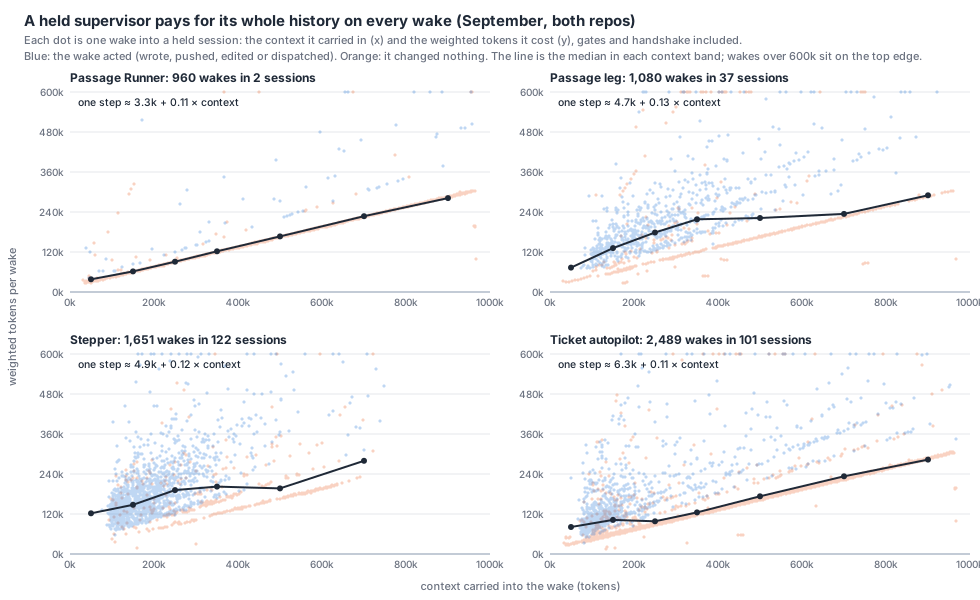
A held supervisor pays for its whole history on every wake. Each model step costs about 3–6k weighted tokens plus 0.11 of everything the session has accumulated, because the whole context is read back from cache. Cost per wake therefore rises in a straight line with history: it is not flat, and it is no worse than linear. A session's total grows a little faster than its number of wakes (exponent 1.1–1.2). Starting fresh is not cheap either. A fresh supervisor spends 116–238k tokens and 0.7 to 2.1 minutes reaching its first decision, plus a 62–82k bootstrap. Its first prompt to a decision is 76–96k tokens, mostly docs and code it reads.
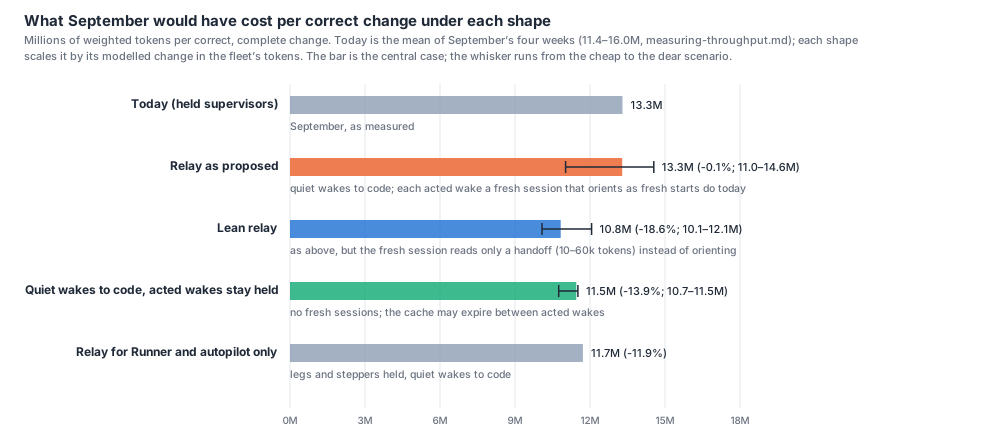
Modelled on September's 6,209 wakes into held supervisors, the relay as proposed would have cost about the same as today: 0% of the fleet's weighted tokens (range −17% to +9%), 13.3M per correct change against 13.3M. The two halves of the relay pull opposite ways. Sending the 3,233 wakes that changed nothing to code removes 16% of the fleet's tokens. Turning each of the 2,976 wakes that acted into a fresh session costs 1.9 times what holding them did, because orientation is 60% of a fresh step's price. The relay saves money only when the fresh step reads a small handoff instead of orienting as today's fresh starts do. That lean relay comes to −19% (range −24% to −9%, 10.8M per correct change). Most of that saving does not need fresh sessions at all: keeping acted wakes held and sending only the quiet ones to code comes to −14% (−19% to −13%). That figure assumes code knows in advance which wakes will change nothing. Code that routes by what it can see, the delivery's class, reaches about −10%.
Little is lost by forgetting. In a blind-coded sample of 48 wakes that acted, no decision rested on a fact only the session's memory held. About a third of the facts the decisions used came from memory, but every one of them had first come from a record a fresh session could read. Of the 25 supervisor failures on record, one recovery clearly depended on held memory (LIN-2078). Eleven of the failures, mostly lost wakes into held sessions, would not exist under a relay.
Findings
Cost per wake rises linearly with the context the session carries, because every step re-reads it. For September's held supervisors (all transcripts, both repos' tickets), one model step costs a fixed few thousand weighted tokens plus about 0.11 times its whole prompt. The slope is mostly the cache-read price itself; the fit explains little of the step-to-step spread (R² 0.09–0.20), which output and cache writes drive:
| Role | Wakes (sessions) | Context at wake, median (p10–p90) | Tokens per wake, median | One step ≈ | Cache read share of wake cost | Context added per wake | Session total ∝ wakes^ |
|---|---|---|---|---|---|---|---|
| Passage Runner | 960 (2) | 482k (133–859k) | 165k | 3.3k + 0.110 × context | 85% | 6.3k | n/a (2 sessions) |
| Passage leg | 1,080 (37) | 293k (130–632k) | 184k | 4.7k + 0.129 × context | 68% | 10.5k | 1.17 |
| Stepper | 1,651 (122) | 202k (117–436k) | 173k | 4.9k + 0.116 × context | 72% | 11.2k | 1.17 |
| Ticket autopilot | 2,489 (101) | 265k (98–743k) | 140k | 6.3k + 0.107 × context | 77% | 6.6k | 1.11 |
A wake here is every delivery into a held supervisor after its own task arrived. It includes
the handshake before it and the completion gates after it, as wake-inventory.md counts an
episode. The slope is the 0.1 weight on cache reads, plus a little. By median per band, a wake
into a Runner holding under 100k tokens cost 38k; one holding over 800k cost 282k, 7.4 times
more. The same band-to-band rise is 4.0× for legs, 2.3× for steppers and 3.5× for autopilots.
Late wakes do not take more steps: steps per wake fall slightly as context grows, because late
wakes are more often quiet. An autopilot's wakes change nothing 26% of the time under 100k and
89% of the time over 800k. So the shape is linear per wake, and a held session's total grows as
roughly the square of its wakes. Over September's range that shows as an exponent of 1.1–1.2,
because a few thousand tokens of context are added per wake against a starting context of about
100k. This extends what-supervisors-do.md's finding that the same gate reply costs three times
as much late in a session as early.
A fresh supervisor takes 0.7 to 2.1 minutes and 116–238k tokens to reach its first decision, plus a 62–82k bootstrap, by role. From the moment a session's task arrived to its first write, push, edit or dispatch, that step included:
| Role (fresh sessions in September) | Tokens to first decision, median (p25–p75) | Bootstrap before the task | Context at first decision | Minutes | What it read, by characters |
|---|---|---|---|---|---|
| Ticket autopilot (101) | 116k (99–131k) | 82k | 76k | 0.7 | docs 45%, code 43%, tracker 4%, dispatch rows 3% |
| Passage leg (37) | 209k (179–236k) | 62k | 93k | 1.6 | code 46%, docs 34%, other proxy 11% |
| Stepper (122) | 238k (201–272k) | 72k | 96k | 2.1 | code 40%, docs 36%, other proxy 10% |
| Plan (273) | 315k (172–457k) | none | 128k | 4.7 | code 54%, docs 11%, tracker 8% |
| Plan-review (217) | 609k (406–821k) | 74k | 138k | 5.9 | code 41%, docs 31% |
| Review (428) | 115k (70–398k) | 69k | 74k | 0.8 | code 27%, git 15%, dispatch rows 14%, docs 14% |
A held wake that acted reached its first action in 0.15–0.56 minutes (median by role), so a fresh
step would add about half a minute to a minute and a half to every judgement, before launch time.
A session's first prompt, before it reads anything, is about 33k tokens of system prompt, tools and
standing files. A supervisor's role prompt is roughly 6–18k tokens more. The rest of the 76–96k a
fresh supervisor carries into its first decision is what it chose to read.
starting-context.md, running alongside this paper, asks what that reading is for.
Cold resumes, LIN-1219's natural experiment, cost more than starting fresh. When a finished session is resumed for a follow-up, its first step re-writes the whole context to cache. In September 130 of 155 resume handshakes into held supervisors were cold, and 48 of 54 failsafe re-confirms. A cold first step cost 1.81 weighted tokens per context token, against 0.11 warm. The 183 cold resumes into held supervisors held a median 152–349k tokens by role, and their first steps alone cost 106M weighted tokens, 3.1% of the fleet's September tokens. Starting the same roles fresh at those moments, up to their first decision, would have cost about 41M. A cold resume costs more than a fresh start once the session holds more than about 100k tokens (autopilot) to 155k (stepper), and most of them did. 95 of the 183 changed nothing.
The relay as proposed would have cost about what September did: 0% of the fleet's tokens (−17% to +9%). In the model, every wake into a held supervisor that changed nothing goes to code at no model cost. Every wake that acted becomes a fresh session of its role. That session pays its role's measured orientation (the steps before a fresh start's first decision) and bootstrap, reads a handoff, and then does the wake's own steps at its smaller fresh context. The central case takes the median orientation, a 20k handoff and the bootstrap. The dear case takes the 75th percentile, a 50k handoff and the bootstrap. The cheap case takes the 25th percentile and a 5k handoff, and drops the bootstrap. It also sends to code each role's acted wakes in the share the coders marked mechanical: Runner 58%, autopilot 50%, stepper 13% and leg 8%, 24% of all acted wakes.
| Shape | Fleet tokens, central (range) | Per correct change (range) | Runner (175M today) | Leg (247M) | Stepper (335M) | Autopilot (440M) |
|---|---|---|---|---|---|---|
| Today | 0 | 13.3M | ||||
| Relay as proposed | −0.1% (−17.1 to +9.4) | 13.3M (11.0–14.6) | −85% | +14% | +76% | −33% |
| Lean relay (fresh step reads only a 10–60k handoff) | −18.6% (−24.2 to −9.3) | 10.8M (10.1–12.1) | −93% | −47% | −24% | −63% |
| Quiet wakes to code, acted wakes stay held | −13.9% (−19.2 to −13.4) | 11.5M (10.7–11.5) | −81% | −26% | −16% | −50% |
| Relay for Runner and autopilot only | −11.9% | 11.7M | −85% | −26% | −16% | −33% |
The relay wins where wakes are mostly quiet and loses where they mostly act. The Runner's wakes change nothing 93% of the time, and the relay removes 85% of its cost. A stepper's wakes act 79% of the time, and each fresh start (208k to orient plus a 72k bootstrap) costs more than the held wake it replaces (median 173k), so the relay raises its cost by three-quarters. Held-supervisor wakes are 35% of the fleet's September tokens: 16.3% in wakes that changed nothing and 18.7% in wakes that acted. As proposed, the relay saves the first and nearly doubles the second.
Code can see a wake's class, not its outcome. The table's shapes send to code exactly the
wakes that turned out to change nothing. Code has to decide before a model reads the wake. By
delivery class it can take pause wakes, failsafe re-confirms, silence re-fires and every delivery
into the Runner. Those are 2,514 wakes: 2,295 quiet, 11.7% of the fleet's tokens, and 219 that
acted, which code would have to pass on. The other 938 quiet wakes, 4.5% of the fleet's tokens,
are terminal and unlabelled deliveries that only a reader can tell from the ones that act. Routed
by class, with acted wakes held, the saving is −9.9% (−9.2% at a five-minute cache): −5.7% from
the supervisors' pause and re-ask wakes and −4.1% from the Runner (survey-check-7.md).
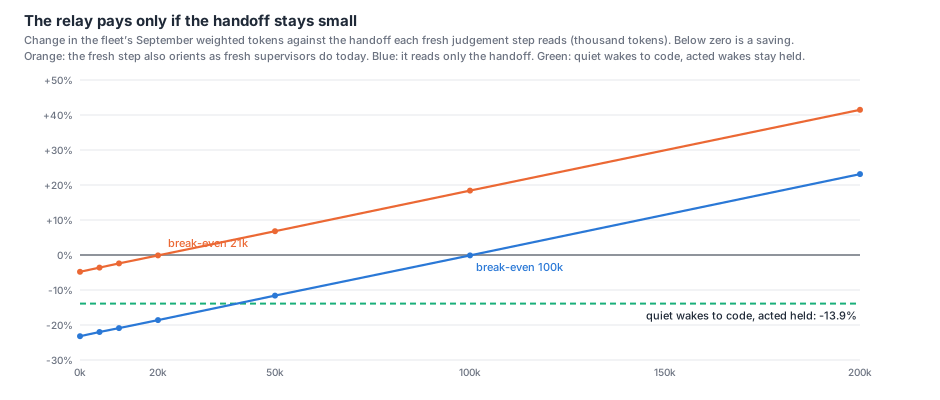
The result turns on the handoff. If the fresh step also orients as fresh supervisors do today, the relay breaks even with a handoff of 21k tokens. If it reads only its handoff, it breaks even at 100k, and every 10k of handoff costs about 2.3 points of the fleet's tokens. The lean relay beats keeping acted wakes held only while the handoff stays under about 40k. The hybrid's figure already pays for about 105 acted wakes whose cache would have expired once the quiet wakes no longer kept it warm. That is about 2 points of fleet tokens, and it barely moves (−13.4%) if the cache lived five minutes instead of an hour.
Per merged change, under both charging rules, the relay costs 7–11% more as proposed, and the lean relay 9–13% less. The cohort is the 298 tickets whose work merged in September and whose first session is in the transcripts: 258 LinearViewer and 50 simple-dispatcher, a change in both counted in both. Charged by the child each wake names, a merged change cost a mean 9.4M weighted tokens (LinearViewer 9.7M, simple-dispatcher 8.6M). Charged to the session each wake entered, it cost 9.1M (9.4M and 8.9M).
| Shape | By the child named (LV / SD) | By the session entered (LV / SD) |
|---|---|---|
| Relay as proposed | ×1.07 (1.06 / 1.13) | ×1.11 (1.10 / 1.10) |
| Lean relay | ×0.87 (0.87 / 0.95) | ×0.91 (0.90 / 0.93) |
| Quiet wakes to code, acted held | ×0.91 (0.91 / 0.95) | ×0.94 (0.94 / 0.94) |
Session starts plus wakes per merged change fall from 20.4 (by the child) or 18.6 (by the session)
to 14.6 under any of the shapes. The cohort's savings are smaller than the fleet's because the
Runner's wakes are charged to the passage epics, which the cohort leaves out (as
wake-inventory.md does), or to legs' tickets that had not merged. simple-dispatcher's changes
save less than LinearViewer's under most shapes and both rules.
A handoff would lose almost nothing: no sampled decision rested on memory alone. Two blind coders read 48 wakes that acted, drawn systematically, 12 from each role, out of 2,970. For each wake they listed the facts its decision used and where each fact lived. They could search the session's transcript up to that moment.
| Where the fact came from | Coder A | Coder B |
|---|---|---|
| The session's memory, first read from a record earlier in the session | 37.5% | 35.8% |
| The delivered wake or dispatch item | 18.8% | 16.9% |
| Harbour's dispatch rows and feedback, read in the wake | 15.1% | 15.7% |
| The tracker | 9.2% | 10.2% |
| The session's own task prompt or standing rules | 8.5% | 9.1% |
| PR, git or code | 5.9% | 6.3% |
| CI | 3.3% | 3.5% |
| The session's notes file | 1.8% | 2.4% |
| Only the session's memory | 0 | 0 |
41–43 of the 48 decisions used at least one remembered fact, and none needed a fact that no record held. The coders put the smallest note that would carry every remembered fact at a median of 300 characters (p90 600, largest 850). On those cards, the handoff would be a few hundred tokens. What makes a fresh step dear is the orientation it does around the handoff, not the handoff itself. The coders marked 32% of the sampled acted decisions mechanical (agreement 85%, κ 0.67): 7 of 12 at the Runner, 6 at the autopilot, 1.5 at the stepper and 1 at the leg. Roles were sampled equally, so weighted by each role's acted wakes the share is 24%.
Recoveries worked from the record. One clear failure depended on held memory, and eleven would
not exist under a relay. Two blind coders read each of the 25 supervisor failures on record with
its comments (wake-inventory-failures.json; agreement 80%, κ 0.64 on what the recovery used):
- From the record: 14–17 recoveries.
- Not recovered in flight: 5–7, which have only a later fix.
- Unclear: 2.
- Needed held memory: 1–2. Both coders put LIN-2078 there. An autopilot was re-woken by
its own abort items. It worked out that it should stop stamping
sessionIdon them, and that remedy lived only in the run's context, so a fresh session would have had to find it again. One coder also put LIN-353 there: the held session noticed a loop because it remembered triggering twice.
Under a relay, both coders judged that 11 failures would not exist, because the mechanism that failed is the held session or its wake delivery: LIN-870, LIN-881, LIN-1059, LIN-1323, LIN-1355, LIN-1357, LIN-1697, LIN-1816, LIN-2511, LIN-2517 and LIN-2720. Most were lost or severed wakes, the stall reaper killing a held session, or a session that only claimed to be holding. They judged 9–11 unchanged and 1–2 worse. The transcripts show the same split:
- Failsafe re-confirms: September's 154 were all answered without a tool call. The session restates its own state, and 48 of the 73 in supervisors paid a cold resume to do it.
- Silence re-fires: 81 of 116 read the record before answering.
Method
Run in order: scripts/survey-held-extract.mjs, scripts/survey-held-sample.mjs, the two blind
codings, scripts/survey-held-failures.mjs (25 proxy reads at one per 10 s, rendered as text for the coders), the two failure
codings, scripts/survey-held-codes.mjs, scripts/survey-held-analyse.mjs and
scripts/survey-held-figures.mjs. Snapshots go to the git-ignored data/survey-held/. Both
codebooks and all four codings are committed in held-or-fresh-codes.json;
survey-held-codes.mjs scores them from that file when the snapshots are gone.
- Population. Every main transcript under
~/.claude/projects/*simple-dispatcher-workspaces*modified since 29 August, read on 1 October: 2,040 dispatched sessions, both repos' tickets. Deliveries and layers are classed exactly assurvey-wake-extract.mjsandsurvey-effort-fleet.mjsclass them, and the counts match that extract. Figures cover 1–30 September. In-session subagents are left out (about 2.6% of tokens). - Cost. A step is one assistant API message, with its usage counted once. Weighted tokens use
fleet-complexity-read.md's weights: input 1, output 5, cache read 0.1, 1-hour cache write 2, 5-minute cache write 1.25; the mid tier ×0.6. A step's context is input plus cache read plus cache write: the whole prompt. A wake's context is its first step's. - Wakes and outcomes. A wake is a delivery into a held supervisor after its own task arrived
(not a gate or handshake), together with the handshake just before it and the gates, compactions
and continues after it. It acted if any step wrote, pushed, edited or dispatched, read from tool
inputs with
survey-check-5-wake.mjs's version 2 write pattern. This counts 6,209 wakes, more thanwake-inventory.md's 4,602, because it includes every delivery into a held supervisor: task notifications, failsafe re-confirms, silence re-fires and the Runner's deliveries whose kind could not be read. - Fits. The per-wake and per-step fits are least squares of weighted tokens on context. The session exponent is least squares of log total on log wakes, over sessions with at least two wakes.
- Fresh starts. For a session whose task arrived in September: tokens and minutes from the task to the first step that wrote, pushed, edited or dispatched. The bootstrap is the turns before the task arrived. The reads are the tool results before that step, classed by the tool call (tracker, dispatch rows, PR and CI, git, docs, code, search). Fresh Runner starts did not occur in September, so the Runner borrows the leg's figures.
- Cold. A first step is cold when cache reads are under half its context.
- The relay.
- Relay as proposed: each acted wake costs its role's orientation (a quantile of the fresh starts' steps before their first decision) and bootstrap, plus a handoff written once to the 1-hour cache. The decision step itself is one of the wake's own steps. Its own steps are re-priced with each prompt moved from the held context to the role's median context at first decision plus the handoff.
- Lean relay: it starts from the bare 33k first prompt plus the handoff and does no other orientation.
- Hybrid: acted wakes stay held. A wake pays a full cold re-write when the last acted wake was more than an hour before but some wake (now gone) came within the hour.
- Fleet change: measured against all September steps in all sessions (3,424M weighted tokens).
- Mechanical share: in the cheap cases, each role's acted wakes go to code in the share both coders marked mechanical for that role.
- By class (
scripts/survey-check-7-held.mjs): code takes pause wakes, failsafe re-confirms, silence re-fires and the Runner's deliveries whatever they led to; those that acted are passed on at their held cost. - Per correct change: applies that change to the mean of
measuring-throughput.md's four September weeks, 13.3M (11.4–16.0M). That figure is fleet tokens divided by correct, complete changes, so it moves one for one with the fleet if the correct rate holds.
- Per merged change. The cohort is tickets named (case-insensitively, in subject or body) by a
first-parent merge on either repo's
origin/maindated 1–30 September, first seen in the transcripts on or after 30 August, excluding the passage epics LIN-3099 and LIN-2888. Each session's own steps are charged to its ticket. A wake is charged by the child its wake text names, else the item's issue line, else the session's ticket, or to the session it entered. The count is session starts plus wakes. - Handoff sample. The population is 2,970 acted wakes. Twelve per role were taken by a fixed stride from the middle of each stride. Two coders worked from the codebook, one in forward and one in reverse order, each split across two agents. Each card gives the delivered text, every step, its calls and clipped results, and the transcript's path for searching earlier lines.
- Failures. The 25 tickets of
wake-inventory-failures.jsonwere read with all their comments from the proxy on 1 October and coded blind by two coders from the failure codebook.
Limits
- The relay is a re-pricing, not a replay. It assumes a fresh step takes the same steps as the held wake it replaces. A fresh session without the history may take more steps to find the facts the held one remembered: 36–38% of facts were remembered, though all were in a record. That would bias every relay figure towards saving. It may also take fewer, since late held wakes carry long contexts that sometimes wander.
- Code is priced at zero. Quiet wakes sent to code cost no tokens in the model, and code that
mishandles a progress wake is not counted.
what-supervisors-do.mdfound 39% of progress wakes led to an action, and here those are counted as acted wakes, not quiet ones. This biases every shape's saving up. The table's shapes also route by outcome, which code cannot see; routed by class, the hybrid's −14% becomes −10%. The by-class figure passes the 219 class-routed wakes that acted on at their held cost, which biases it towards saving. - The central relay carries the bootstrap. Broker-armed launches already skip it for some kinds. Without it, the relay as proposed comes to −6%. The cheap case drops it.
- The lean relay assumes a fresh step reads nothing beyond its handoff. Today's fresh supervisors read 40–60k tokens of docs and code by choice or by prompt. If a relay step did the same, it would move to the "as proposed" line. The lean figure is a bound on what a deliberately small step could reach, so it is biased towards saving.
- The hybrid ignores slower context growth. Removing quiet wakes would also stop the 6–11k of context each one adds, so later held wakes would be cheaper. This biases the hybrid's saving down. The cache penalty assumes the session's cache lives an hour. At five minutes the saving moves by half a point.
- "Acted" is read from tool inputs. A scratch-file write counts as acting, so some quiet wakes are counted as acted. That moves the relay towards its dear side.
- The Runner is two sessions. No fresh Runner start was observed, so the Runner borrows the leg's orientation. The Runner's 84–93% saving describes two voyages.
- Per correct change assumes the correct rate holds. If fresh steps judged worse, cost per correct change would rise and the scorecard would show it. The model cannot, so it is biased towards saving. The per-merged-change cohort counts every merged change, correct or not.
- The handoff coders are models of the tier under study, reading cards. A remembered fact counts as recorded if it appeared in an earlier tool result, but a fresh session would still have to know where to look. With 0 of 48 memory-only decisions, the 95% upper bound is about 6% of acted wakes. Roles were sampled equally, so the Runner is over-represented against its 67 acted wakes. The handoff size is the coders' estimate.
- The failure record under-counts memory-dependent recoveries. Recoveries are rarely written down: 7 of 25 have no stated recoverer, and a held session that fixed itself quietly leaves no ticket. This biases the memory share down. The "avoided" judgement also ignores the new failure modes a relay would bring, such as a lost handoff or a fresh step launched twice. That biases the relay's safety up.
- September only. Transcripts were read on 1 October while the V1 passage was flying. September rows do not change, but a Runner session in October could relabel a few sessions as legs on a re-run. The weights make cache reads the dominant cost, so a change in cache pricing would change the shape.
Options
Each option is sized from this paper. None is a change; John decides.
| Option | Estimated effect | Evidence | Risk to correctness | How the scorecard measures it |
|---|---|---|---|---|
| A. Code delivers or absorbs the wakes that change nothing; acted wakes stay held (the anchor's map rows 1–2, and the gate replies that follow those wakes) | About −10% of weighted tokens routed by delivery class (−5.7% supervisors' pause and re-ask wakes, −4.1% the Runner); −14% (−19% to −13%) if code could tell which wakes will change nothing; 11.5–12.0M per correct change | 3,233 quiet wakes are 16.3% of fleet tokens, 11.7% in classes code can see; the cache-expiry cost is about 2 points | Lost wakes are the most common failure (15 of 25); the plumbing moves rather than disappears. Code must still pass on the 39% of progress wakes that lead somewhere | Tokens and wakes per correct change; correct rate; lost-wake incidents |
| B. On top of A, a lean fresh session for each judgement step | A further −5 points at a 20k handoff (−9 at none), falling to 0 at about 40k; worse than A above it | 0 of 48 decisions needed memory alone; handoff notes 300–850 characters; role prompts about 6–18k tokens | Behavioural fixes that live only in a run's memory (LIN-2078) are lost; judgement quality without history is unmeasured; about 0.5–1.5 minutes more per step | Review send-backs and escapes per correct change; tokens per judgement step |
| C. Start fresh instead of resuming cold once a session holds more than about 100–155k tokens | About −1.9% of fleet tokens alone (106M of cold first steps against about 41M fresh); about −0.8% on top of A, which already sends the 95 cold resumes that changed nothing to code; inside B and D | 183 cold resumes; 1.81 against 0.11 tokens per context token | As B, for those sessions only | Tokens per correct change; cold-resume count |
| D. The relay as proposed, with today's orientation | 0% (−17% to +9%): no reliable saving | Orientation is 60% of a fresh step's cost; a stepper's cost rises by three-quarters | As B | Not recommended without B's small handoff |
Next
- How many steps does a fresh session take to reach the decision a held wake made? Replay a sample of acted wakes as fresh sessions in a sandbox, from the record and a short handoff. Count the steps and tokens, and whether the decision matches. That replaces this paper's re-pricing assumption with a measurement, and it is the number options B and D turn on.
- What do fresh supervisors read to orient, and how much of it do their first decisions use?
This is
starting-context.md's question, running alongside. It decides whether the lean relay's bound can be reached. - What would code need to know to answer a progress wake that today leads to an action?
Following
what-supervisors-do.md's Next. It decides how much of option A's 16% code can take safely.