Had a simple size-and-risk classifier sorted Harbour's past tickets, how many could have taken a lighter process, and what would have escaped among them?
Between a tenth and a third of them, depending on the rule. Very little escaped in any light group, but the full process did catch things there, on changes whose paths looked safe. On the merge-time light groups most of those catches came at plan review (13 of 17 findings under M4). Six rules were fixed and committed before any outcome was read. They were run over the 1,282 Done changes merged since 1 June in both repos. The two docs-and-tests-only rules route 11% light. Not one of those changes went wrong after merge once the scorecard's failures were read (95% interval 0 to 4 in 100). The small-and-low-risk-path rule routes 26% light. Five of its 249 mature changes went wrong after reading (2 in 100). Its light group used 13% of the working hours. On the price side, a plan review or code review caught a real fault before merge on 5 of the docs-only changes and on 8 of the small-and-low-risk ones. In both groups most of these came from plan review. The docs-only catches were not ordinary docs: two were parent tickets whose code shipped under child tickets, one was a runbook whose commands could not run, and two were prompt text served to agents. The plan-time rule reads only the ticket's text. It is the cheapest to apply and the least safe to trust: 3 of its 116 mature light changes went wrong, and review caught 36 real faults on its light group. Among them were agent reads that would have widened to the whole workspace, and one ticket with 15 faults. The merge-time light groups cost about half the dispatches and hours of the heavy groups per change, and a third of the tokens. That is mostly because they are smaller. Held to the same diff size, a docs-or-tests-only change took about the same dispatches as a production change, so the process is not lighter on light work today. Even so, the most a lighter process could save is what the light groups cost now: at most 18% of working hours (M4) and 13% for the small-and-low-risk rule, or 30% and 21% of dispatches.
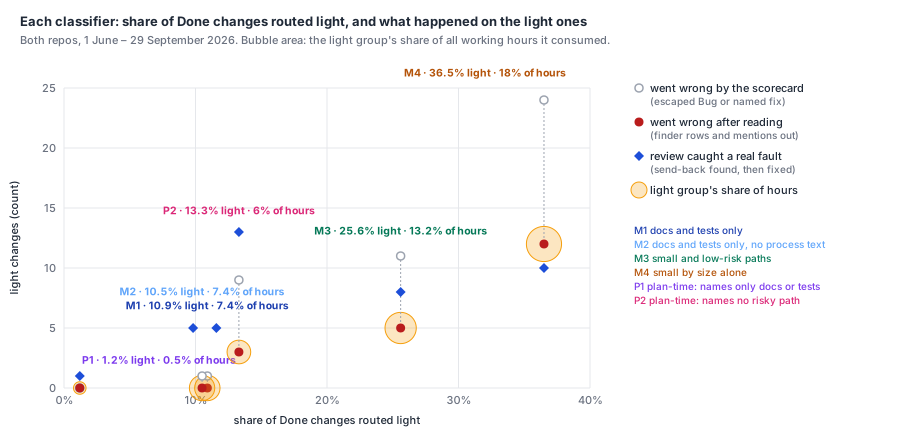
Changes are the throughput scorecard's (measuring-throughput.md:41). A change is a ticket
whose id names a first-parent merge on origin/main since 1 June, in LinearViewer (Harbour) or
simple-dispatcher (the runner). Here only changes that reached Done count: 1,282 in all. 1,076
touched Harbour only, 187 the runner only and 19 both. Mature changes merged at least 30 days
before 30 September, so an escape or fix had time to show: 984 of them. Went wrong uses the
scorecard's own tests, an escaped Bug naming the change or a later fix commit naming it
(:42). After reading removes two kinds of false positive. The first is escapes that name the
ticket whose review found an older fault (survey-check-2.md:301-312). The second is named fixes
that only mention the change. Review caught a real fault means a plan review, code review or
close-out hold sent the change back over a defect that would otherwise have shipped on main, and
the defect was then kept off main. For 47 of the 50 it was fixed before merge. For three (LIN-2511,
and two on LIN-2872) the faulty part was descoped to its own ticket. Every number covers both
repos unless a repo is named.
Findings
The six rules, fixed before any outcome was read. Four apply at merge time, from the paths and lines a change touched. Two apply at plan time, from the ticket's title and description and the repository paths that text names.
| Rule | Light when… |
|---|---|
| M1 docs and tests only | no production lines |
| M2 … without process text | M1, and no CLAUDE.md, AGENTS.md, docs/architecture/ or .claude/ file |
| M3 small and low-risk paths | ≤ 49 production lines in ≤ 3 files; no auth, data-store, prompt/template or CI path; no path a CLAUDE.md invariant names; no process text |
| M4 small by size alone | ≤ 49 production lines in ≤ 3 files, any path |
| P1 plan-time, docs or tests named | the text names a path, every named path is docs or tests, and no risk word appears |
| P2 plan-time, nothing risky named | the text names a path, none is risky, invariant or process text, and no risk word appears |
How many go light, and what they used. The light groups are small changes, so each costs less. None of them used more than 18% of the working hours, or 30% of the dispatches.
| Rule | Light | Harbour | runner | Share of dispatches | of working hours | of tokens | Median dispatches, light / heavy | Median working hours | Median tokens (M) |
|---|---|---|---|---|---|---|---|---|---|
| M1 | 140 (10.9%) | 12.2% | 4.8% | 12.1% | 7.4% | 7.9% | 7 / 12 | 1.0 / 1.5 | 24 / 70 |
| M2 | 134 (10.5%) | 11.7% | 4.3% | 12.0% | 7.4% | 7.9% | 8 / 12 | 1.1 / 1.5 | 24 / 68 |
| M3 | 328 (25.6%) | 26.8% | 21.4% | 21.3% | 13.2% | 12.9% | 7 / 13 | 0.9 / 1.7 | 28 / 74 |
| M4 | 468 (36.5%) | 37.3% | 34.2% | 29.7% | 18.0% | 17.0% | 8 / 14 | 1.0 / 1.8 | 30 / 78 |
| P1 | 16 (1.2%) | 1.3% | 1.1% | 1.0% | 0.5% | 0.5% | 1 / 11 | 0.4 / 1.5 | 5 / 63 |
| P2 | 170 (13.3%) | 14.0% | 9.6% | 8.6% | 6.0% | 9.6% | 7 / 13 | 1.0 / 1.5 | 42 / 64 |
Shares by repo. The Harbour and runner columns give each repo's own share routed light. The 19 changes that touched both repos go light only under M4 (3) and P2 (1).
Coverage of the effort columns.
- Dispatches come from the runner's run logs and cover 734 changes. June is mostly missing.
- Working hours come from its oplog, from 12 July, and cover 665 changes.
- Tokens come from local transcripts and cover 171 changes, almost all in September. They count only claude-code sessions, and only for a change whose every session left a transcript.
The light group still gets reviewed. Going by comment headings, a docs-and-tests-only change was code-reviewed 58% of the time and sent back 16% of the time, against 70% and 19% for its heavy group. M3's light group was code-reviewed as often as its heavy group (69% and 68%), and sent back half as often (11% and 21%). The heavy figures are weighted from the 1-in-4 sample.
Why the light groups cost less: size, not process. Per change, a docs- or tests-only change used about a third of a heavy change's tokens and three-fifths to two-thirds of its dispatches and hours. The light groups' median diff is 98 to 155 lines, docs and tests included; the heavy groups' is 300 to 430. Compared within bands of the same total lines changed (1–49, 50–149, 150–499, 500+), weighted by the light group's mix:
- a docs- or tests-only change used 0.96 of a production change's dispatches, 0.78 of its hours and 0.54 of its tokens;
- an M3 light change used 0.85, 0.80 and 0.79 of an M3 heavy change's;
- among changes of at most 49 production lines in at most 3 files, those heavy only because of their paths used the same dispatches and hours as M3's light ones (ratios 1.00 and 1.04).
So today's process spends about as much on light work as on heavy work of its size.
Why the saving is bounded. The bound is arithmetic. The most any light lane could save is what its group costs now, less whatever the light process still spends: 7% (M1) to 18% (M4) of working hours, 12% to 30% of dispatches, 8% to 17% of tokens.
- Hours cover only changes from 12 July. Costing the uncovered changes at their group's covered mean moves the hours share by at most a point (M1 6.2%, M3 12.9%, M4 17.8%). June is not richer in docs-only changes than the rest (12% against 11% overall); September is (18%).
- The "77%" in
docs/steady-base.md:25is a per-ticket ratio, not a total saving: a docs-only ticket against the median ticket, in weighted tokens, from a sample of 87 (where-the-effort-goes.md:155-163). On this census a docs- or tests-only change used 64% of the median change's dispatches and 69% of its hours, close to it, but 38% of its tokens (raw tokens, September, 30 changes).
Almost nothing escaped in the light groups, and the escapes that did were visible in the code. Every mature light change that the scorecard counts as not correct was read.
| Rule | Mature light | Not correct, scorecard | After reading | Per 100 (95% interval) | Heavy group, scorecard, per 100 |
|---|---|---|---|---|---|
| M1 | 89 | 1 | 0 | 0 (0–4.1) | 11.1 |
| M2 | 85 | 1 | 0 | 0 (0–4.3) | 11.0 |
| M3 | 249 | 11 | 5 | 2.0 (0.9–4.6) | 12.1 |
| M4 | 360 | 24 | 12 | 3.3 (1.9–5.7) | 12.2 |
| P1 | 8 | 0 | 0 | 0 (0–32) | 10.2 |
| P2 | 116 | 9 | 3 | 2.6 (0.9–7.3) | 10.5 |
The heavy column is the scorecard's rate before reading, so it is not directly comparable with the light column after reading. Both fall on reading, because both carry finder rows and mere mentions (Limits). On the scorecard's own terms, the docs-and-tests-only groups fail a tenth as often as their heavy groups, M3 a third as often, M4 about half as often and P2 three-quarters.
Every escape in a light group, by name:
M1 and M2. One on the scorecard: LIN-2331, named by LIN-2414. That is a finder row, a pre-existing fault the change's review found and routed out (
survey-check-2.md:311). None after reading.M3. Five after reading, all in Harbour.
- Escaped Bugs:
- LIN-1447 (23 lines,
routes/dispatch.js). Its compat lane issued ownerless broker tokens, and every workspace verb returned 503 (LIN-1576). The path names no auth word; the change was about tokens. - LIN-2252 (5 lines of CSS). The padding fix was inert (LIN-2272).
- LIN-2355 (17 lines). It left the proxy preamble half unfixed for non-Linear workspaces (LIN-2804).
- LIN-1447 (23 lines,
- Named fixes that blame the change:
- LIN-1485: a
length === LIMITtruncation test (LIN-1494). - LIN-2123: a resume-marker fix that never fired (LIN-2268).
- LIN-1485: a
- Removed on reading: three finder rows (LIN-2037, LIN-2291, LIN-2331) and three named fixes the reading did not find to blame the change (LIN-805 and LIN-1492 unclear, LIN-2262 a mention).
- Escaped Bugs:
M4. M3's five, plus seven changes on risky paths:
- LIN-1318, kickoff prompt wording that defeated push wake;
- LIN-1471, runner
dispatcher.js, duplicate wakes; - LIN-2227, a data store, old rulings resurfacing;
- LIN-811, a close-out gate that missed the bug path;
- LIN-1239, a grounding layer reverted as inert;
- LIN-1982, a sibling selector it declined to fix;
- LIN-2124, a wording clause that stalled sessions.
LIN-1471 is the one runner change. So M3's path rules removed seven of M4's twelve for 140 fewer light changes.
P2. Three after reading:
- LIN-442 (343 lines): a toggle desync after lazy-loading (LIN-525).
- LIN-1736 (574 lines): a cross-workspace
decision_idcollision in the KPI join, blamed by LIN-2291. - LIN-2252, as above.
Two of the five M3 failures, LIN-2123 and LIN-2252, were found by a review sweep of work already
merged, not by the change's own review. None of the five involved auth or data loss, except that LIN-1447's fault
was in token handling behind an innocuous path. Of the seven named fixes that blame a light change, the coder judged five could have been caught
by reading the diff (reviewCouldCatch in proportional-process-backtest-codes.json).
The full process did catch real faults on light changes, mostly at plan review. Every light change that a plan review or code review sent back was read, close-out holds on it included: 72 changes, 116 genuine send-backs, 369 findings. Of those findings, 170 changed only wording, 76 only tests, 37 were filed as follow-ups and 84 changed production code. 50 were real faults, on 21 changes; three more were found only after merge, and those are counted above as escapes or fixes, not here. This is what each light group would have put at stake:
| Rule | Light changes with a real fault caught | Real-fault findings | By plan review / code review / close-out |
|---|---|---|---|
| M1, M2 | 5 of 140 (3.6%) | 12 | 9 / 3 / 0 |
| M3 | 8 of 328 (2.4%) | 15 | 11 / 4 / 0 |
| M4 | 10 of 468 (2.1%) | 17 | 13 / 4 / 0 |
| P1 | 1 of 16 | 2 | 2 / 0 / 0 |
| P2 | 13 of 170 (7.6%) | 36 | 15 / 18 / 3 |
The tickets, and what the full process caught on each:
- Docs-and-tests-only changes (M1, M2), five changes.
- Parent tickets whose code shipped under their children:
- LIN-2994 (Harbour). Plan review found the halt routes colliding with
/dispatch/:idand a UUID guard, which would have given a proxy 404 and a dashboard 400. - LIN-2995 (runner). Plan review found five faults: a stop sweep that missed held sessions the failsafe would refire, a resume hold that starved aborts, and three more.
- LIN-2994 (Harbour). Plan review found the halt routes colliding with
- LIN-3001 (Harbour), a docs-only runbook. Review found an inverted rollback rule and two
mongoshcommands that could not reach the database. - Agent-facing prompt text:
- LIN-2175. Plan review found a Runner prompt contradicting its own hard rule, and a launch goal the kickoff's first act would override.
- LIN-1812. Plan review found a false budget claim (low confidence).
- Parent tickets whose code shipped under their children:
- Small and low-risk paths (M3), those five plus three small code changes.
- LIN-1801: a title rendered into the label column on mobile.
- LIN-2353: a missed sibling dispatch producer that would still have told workers "Linear".
- LIN-2701: a sync-to-async Express handler that would hang on a render throw.
- Small by size (M4) adds two more.
- LIN-2333: a gate that never fired for the parked anchors it targeted.
- LIN-2511 (runner): an unbounded guard that would have left dead-hook sessions stuck.
- Plan-time (P2) routes large changes light when their text names little. Ten of its 13
are over 100 lines.
- LIN-2934 (700 lines) had 15 real faults caught. Among them: the feed's "n of N" would have been served stale for 30 days, a duplicate count, and an off-by-one.
- LIN-2025 (245 lines). Plan review stopped agent proxy reads silently widening to the whole workspace on an unmatched team id.
- LIN-2719 (848 lines): a model picker that would have dispatched its placeholder as the model.
- LIN-2872 (Harbour, 122 lines): a change that would have removed the duplicate-dispatch guard for every failed opencode dispatch.
- LIN-1963 (993 lines): a research baseline diluted 45×.
- LIN-2253 (452 lines): a 12.5× dilution of cost figures on the public
/kpispage would have come back. - Others: LIN-1358, LIN-1908, LIN-1958, LIN-2717, LIN-2830.
Most of the rest of what the process bought on light changes was evidence and wording. On 51 of
the 72 sent-back changes it caught no real fault, and on 44 it changed no production code.
which-rules-pay.md coded review consequences on 83 recent tickets and overlaps here.
- M1 and M3. Its codes find no production change on M1's light tickets, and one on M3's (LIN-2787, not a fault).
- P2. On P2's light tickets they find 24 production changes and 15 real faults across 8 tickets. Those include LIN-2760 and LIN-2771, which no send-back reached: their faults were caught under an approving review's ledger. So the table above undercounts catches (Limits).
For scale: across its 100 code-reviewed September tickets, review fixed 44 real faults in 18
tickets (which-rules-pay.md:55). That is 18 in 100 there, against 2 to 4 in 100 on the
merge-time light groups here. The populations differ, since which-rules-pay excluded docs-only
and research tickets.
The merge-time rules are stable month to month; the docs-only rule is not; the plan-time rules drift up.
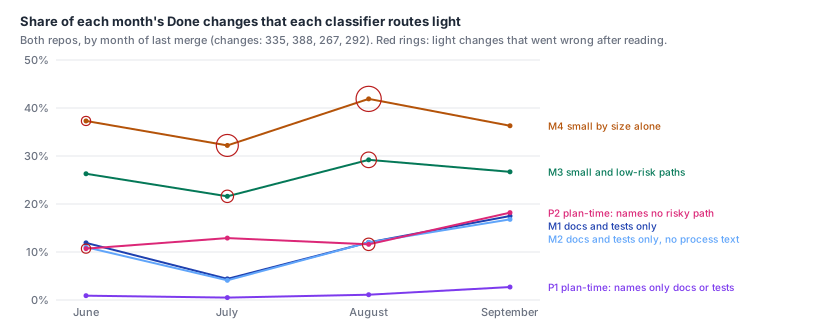
M3 and M4 are stable. M3 routes 26%, 22%, 29% and 27% light in June to September, and M4 37%, 32%, 42% and 36%.
M1 is not. It routes 12%, 4%, 12% and 18%. July's dip follows the regime change
why-throughput-halved.md:67-68describes, when docs- or tests-only changes fell. September's rise is partly this survey series: 18 of its 51 docs/tests-only changes touchdocs/papers/, against none in June.The plan-time rules drift up. P2 routes 11%, 13%, 12% and 18%, and P1 routes 1–3%. That is consistent with ticket text growing longer and naming more paths (
writing-length.md).Where the misses fall. M3's five went-wrong changes fall in July (2) and August (3), and M4's twelve in June (1), July (5) and August (6). September changes are not yet mature.
Whether each rule catches what later went wrong. Of the 100 mature changes the scorecard counts as not correct:
Rule Sent heavy M1, M2 99 M3 89 M4 76 P1 100 P2 91 After reading, M3 lets through 5 true failures and M4 lets through 12. The size rule alone (M4) misses a quarter of what went wrong. The path rules in M3 halve that at the cost of routing 140 fewer changes light.
Method
# reuse the scorecard's same-day snapshots (measuring-throughput.md's Method: survey-effort-git,
# -runner, -fleet, survey-reliability-github, -tracker, survey-scorecard), and survey-rules-fetch's
# data/survey/rules-tickets.json (which-rules-pay.md), then:
node scripts/survey-proportional-classifiers.mjs  # per-change paths and text features, the six rules → data/survey-proportional/features.json
node scripts/survey-proportional-tokens.mjs       # per-change transcript tokens → data/survey-proportional/tokens.json
node scripts/survey-proportional-fetch.mjs        # comments for every light change + 1 in 4 heavy (proxy, 4.5 s a call)
node scripts/survey-proportional-backtest.mjs     # the join, every table above → data/survey-proportional/backtest.json
node scripts/survey-proportional-digests.mjs      # reading digests of light changes a review sent back
node scripts/survey-proportional-codes.mjs        # assemble the committed hand codes
node scripts/survey-proportional-backtest.mjs     # re-run with the codes
node scripts/survey-proportional-chart.mjs        # the two SVGs
node scripts/survey-check-4-proportional.mjs size    # version 2: light against heavy with diff size held fixed
node scripts/survey-check-4-proportional.mjs shares  # version 2: the ceiling in hours, dispatches and tokens, and coverage-adjusted
- The rules came first.
survey-proportional-classifiers.mjswas committed asbff7e149before the backtest joined any outcome, and not changed afterwards.- The risk path patterns extend
survey-effort-git.mjs's. - Invariant paths are the files each repo's CLAUDE.md invariants govern, at the scorecard's heads.
- The risk words are a fixed list: auth, credential, token, secret, security, permission, grant, encrypt, revoke, login, password, migration, schema, database, mongo, data loss, state-store, sessions.json, invariant, meta-prompt and prompt template.
- Paths are read from git at the scorecard's heads with
survey-effort-git.mjs's attribution rule. They reproduce its production-line count for all 1,311 changes with no mismatch. A re-run later in the day loses one June merge of LIN-295, because git reads a bare--sincedate at the current time of day. LIN-295 is heavy under every rule, so no figure moves.
- The risk path patterns extend
- Size held fixed (version 2).
scripts/survey-check-4-proportional.mjs sizecompares light and heavy changes within bands of total lines changed, production, tests and docs together, noise excluded. Each band's ratio of medians is weighted by the light group's count in it. - Population and outcomes. These are the scorecard's per-change fields, from
data/survey/scorecard.json(cut 30 September, window 30 days), filtered to Done. The escape list is recomputed with its window and checked equal to its count. Named fixes are recovered from git with its rule, so they can be named. - Effort.
- Dispatches and working hours are the scorecard's, from
survey-effort-runner.mjs. - Tokens are input, cache and output tokens over each claude-code session the run logs map to
the change, from
~/.claude/projects, with message ids counted once and subagents included. - Review rounds come from comment headings, using
survey-rules-timeline.mjs'slegOfandverdictOf. - Comments come from three sources: the tracker and rules snapshots already on disk, and 560 proxy fetches. Together they cover every Done change any rule routes light (558, a census) and a systematic 1-in-4 sample of Done changes every rule routes heavy (184, weighted 4).
- Dispatches and working hours are the scorecard's, from
- Reading.
docs/papers/harbour/proportional-process-backtest-codes.jsonholds every hand code.- Finder rows are
survey-check-2.md's eight changes named only by them. - Named fixes: all 25 pairs on light changes were coded blames, unclear or mention against a written rubric. 7 blame.
- Review catches: every light change with a heading-labelled send-back (72) was coded. Each send-back finding was followed to what it changed, against a rubric fixed before reading.
- The ten coders were given the same conventions. The last six had them written into their brief, after the first four applied them independently.
- The author set
realFaultfalse on three findings made by a review after merge. Those faults had shipped, and are counted as escapes or fixes (LIN-2123, LIN-2124, LIN-2252;adjustmentsin the codes file).
- Finder rows are
- Proxy. 560 calls at one per 4.5 s, under the survey's shared 15 a minute. The only writes were the ticket's status and its closing comment.
Limits
- Selection: the full process ran on every change here. A light-group escape is a fault the heavy process also missed. What a lighter process would have missed is shown only by what the heavy one caught (the catches table). Its effect on the escape counts is unknown, and they understate a light lane's risk.
- The catches are undercounted. Only send-backs were coded. Faults fixed under an approving
review's ledger (LIN-2760 and LIN-2771 in
which-rules-pay), or caught by an implementer before any review, are missing. This biases the price of a light lane down. The size of the bias is unknown, but which-rules-pay's overlap suggests it is largest for P2. - Attribution noise.
- A parent ticket whose code landed under its children looks docs-only (LIN-2994, LIN-2995). This makes docs-only rules look riskier than a docs change is, and hides that the parent's plan review shaped code elsewhere.
- A change whose risk is in its content, not its path names, looks low-risk (LIN-1447: tokens
in
routes/dispatch.js). This makes merge-time path rules look safer than they are.
- The escape and fix tests are text matches.
- Only about 31 of 190 escaped Bugs name a change at all (
measuring-throughput.md:228-231), so escapes are undercounted in both groups.reliability-baseline.md:82-86also finds attributed escapes rarer on small changes (0.7 against 2.5 in 100), so the pattern here is not new. Whether faults in small changes are less often attributed is unknown. - The reading removed false positives only in the light groups. So the light-versus-heavy gap before reading is the fair comparison, and the gap after reading is overstated.
- Only about 31 of 190 escaped Bugs name a change at all (
- The send-back heuristic mislabels. Coders found plan revisions, shadow reviews and orchestrator overrides headed "request changes". The review-round and send-back shares in the effort table come from the heuristic and run high. The coded counts do not.
- The plan-time rules read today's ticket text. Descriptions are edited after planning, and scope amendments add paths. The plan-time rules are better informed here than they could have been at plan time, which biases them to look safer.
- Maturity and coverage.
- September's 292 changes are in the shares but not the rates. They have the most docs-only changes, and their outcomes are unknown.
- The effort columns cover subsets. Dispatches start in late June and hours on 12 July. Tokens are September claude-code sessions only: 30 changes in M1's light group and 17 in P2's. So the token medians are indicative only.
- Small counts. Every light-group rate rests on 0 to 12 events. The intervals are printed; P1's is 0 to 32 in 100.
- Size is held fixed only roughly. Four bands of total lines are coarse. Within a band a light change can still be smaller than a heavy one, which makes light work look cheaper than it is, so the ratios near 1 are if anything low. The token bands are thin: 2 to 11 docs- or tests-only changes each.
- One coder per item, not second-read.
- LIN-2934's codes overlap
which-rules-pay's. Here it has 15 real faults and 22 production changes. Without plan review it has 10 and 15, the same as there, where plan review was excluded. - Marginal calls are listed in each batch's codes: docs errors as real faults, and approve-conditional items as close-out findings.
- LIN-2934's codes overlap
Next
What John would need to decide, not what to build:
- What price is acceptable. Under M3, a lighter process would have put at stake the faults review caught on 8 of 328 changes, to save at most 13% of hours (21% of dispatches). It also carries the 5 escapes that happened anyway. Is that the right trade, and is it the same for Harbour and the runner?
- Whether "light" means fewer legs or lighter legs. On merge-time light changes, most real faults came from plan review, not code review. Which legs a light lane keeps decides most of its risk.
- Whether a merge-time rule can be applied at plan time. The plan-time rules are either near-empty (P1) or route large, faulty changes light (P2). The merge-time rules need the finished diff. Where the decision sits is a question in itself.
- What counts as docs. Runbooks, served prompt text and parent tickets whose code ships under children behave like code. Should a rule treat them so?
Proposal line added to proposals.md: after the same reading, what share of the heavy group's
scorecard failures survive? Without it, light and heavy cannot be compared on the same footing.