Which failures in Harbour are invisible to any single session, how often did each happen, what did it cost, and would a detector in code have caught it?
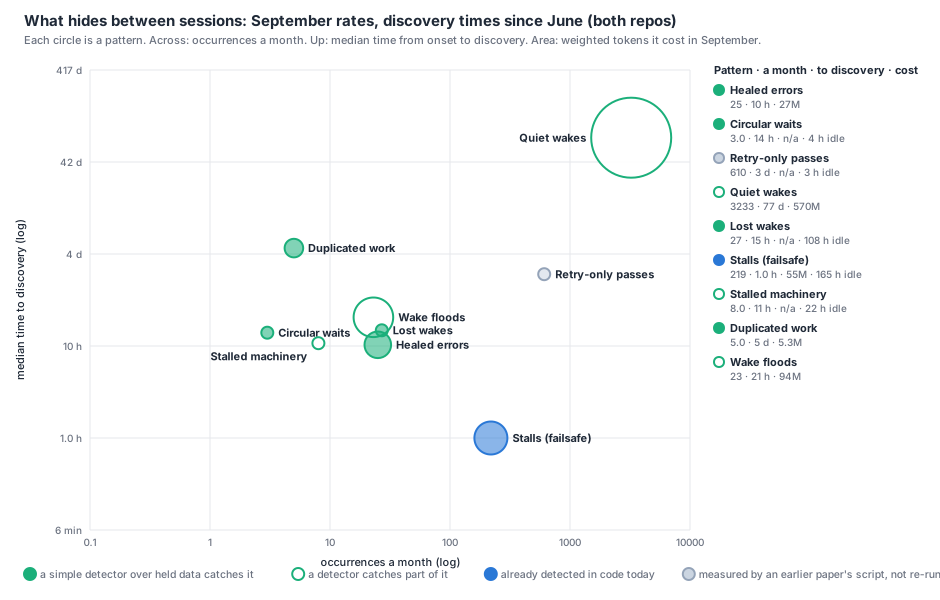
Most of them, often, and yes for about two in five of those on record. The tracker holds 107 incidents since June, 101 of them in nine cross-session patterns, and 92 of the 107 were invisible to any one session that met them. They surfaced a median of 16 hours after they began, but that figure is driven by onsets known only to the day: where the record gives an onset's time, the median is 3 hours. Supervisors found 28, the worker that hit one 26, John 19, a review or measurement 13, a Flight Companion 9 and code 3. No periodical found one: the periodicals' only first find was their own four-week outage. Simple rules over data Harbour and the runner already hold were run over the history. They caught 9 of the 19 incidents on record that their windows scored, a median of 5 hours before anyone filed them (9 of 24 if the feedback rule's own window counts). They raised 93 alarms that are on no ticket. On a hand check of a sample, about 40 of those are distinct real faults; most of the rest are errors that healed in minutes with no harm. Together the rules take under a minute of CPU a month and no model tokens. The dead credential of LIN-3181 would have alarmed 1.5 hours after onset instead of 10. The 1 October circular wait would have alarmed 5 minutes before the Flight Companion broke it. The overnight death of the dispatcher on 26 September would have alarmed 9 hours before John found it. The rules miss sessions that leave no transcript (the opencode harness, launches that never start), single-session events, and failures of the process that hosts the watcher. By token cost the largest pattern is the one already on the map: wakes that change nothing, 16% of September's tokens, found as an aggregate only after about 11 weeks. By idle wall-clock the largest are lost wakes (108 hours in September by the wait graph, 42 of them in sessions still waiting) and stalls (165 hours, already caught in code, after 60 minutes). The detectors save time to discovery far more than tokens. Code detects, the model decides fits this record: the instruments that exist today are self-scoped by construction, and the agents' vigilance that the prompts ask for sees each instance but never adds them up.
Findings
Nine patterns, 107 incidents on record, nearly all cross-session. A hand-coded register
(what-hides-between-sessions-register.json) keeps every ticket since about 1 June that records an
instance of a pattern happening, from 468 regex candidates in a snapshot of all 3,132 tickets. It
adds the 25 supervisor failures on record, the 8–9 August 401 flood and the 1 October circular
wait. Two buckets were added to the brief's seven: P8, loops and wake floods; and P9, collisions
over shared state between concurrent sessions (3, all in the runner).
| Pattern | On record | Harbour / runner / both | Median hours to discovery (n) | Found by, most often |
|---|---|---|---|---|
| P1 Healed or masked errors (auth, retries) | 10 | 9 / 1 / 0 | 10.3 (9) | a worker that hit it 4, Flight Companion 3 |
| P2 Circular or orphaned waits | 10 | 3 / 5 / 2 | 13.9 (8) | mixed: John 2, review 2, unknown 3 |
| P3 Tests that pass only on retry | 20 | 18 / 2 / 0 | 60.4 (11) | the worker that hit it, 16 of 20 |
| P4 Wakes that change nothing | 3 | 2 / 1 / 0 | — (an aggregate, see below) | measurement |
| P5 Lost wakes | 20 | 4 / 11 / 5 | 14.8 (10) | supervisor 9, John 5 |
| P6 Stalled sessions | 22 | 2 / 19 / 1 | 10.7 (14) | John 8 |
| P7 Duplicated work | 4 | 4 / 0 / 0 | 116 (2) | supervisor 3 |
| P8 Loops and wake floods | 9 | 7 / 2 / 0 | 20.5 (2) | supervisor 5 |
| All, with P9 and 6 others | 107 | 54 / 44 / 9 | 15.8 (65; 0.1–210) | supervisor 28, worker 26, John 19 |
"Repo" is where the fault lived and was fixed. Harbour's faults are credentials, flakes and
minting. The runner's are delivery, holds and stalls, as wake-inventory.md v2 found for lost
wakes (11 of 15 in the runner). The median fix landed 9.7 hours after filing. Discovery, not
repair, is the slow step.
What the patterns cost in September. Each row's rate comes from the instrument that measured
the month (survey-hides-analyse.mjs names it). Tokens are weighted as in the earlier papers, out
of September's 3,497M.
| Pattern | September | Weighted tokens | Idle wall-clock | Detector |
|---|---|---|---|---|
| P1 Healed errors | 25 bursts of one error across 3+ sessions in an hour; 487 proxy errors seen by sessions (Harbour 417, runner 70), 68% healed by a retry | 26.6M retrying (0.76%, an upper bound) | a few hours per burst | D1 caught |
| P2 Circular waits | 3 recorded waits (LIN-2559, LIN-2630, LIN-2932), and the 1 October cycle just after the month | none | 3.5 h, the cycle's hour included | D2 caught the cycle |
| P3 Retry-only passes | about 610 green CI runs a month hid a retried test (browser-flakes.md v2: 80% of a 1-in-8 sample) |
not measured | 54 re-runs, about 7½ h since June | cited, not re-run |
| P4 Quiet wakes | 3,233 deliveries into held supervisors (held-or-fresh.md v2) |
570M (16.3%) | none | partly: 2,295 visible by class |
| P5 Lost wakes | 27 waits on a child that had finished, never woken; 14 more woken late, 13 of them by 24–47 min and one by 5.3 h; 8 failed terminal posts | not measured | 108 h (capped at 6 h each), 66 h of it in waiters the runner had already completed; plus 18 h late | D2, D5, D5x |
| P6a Stalls the failsafe sees | 219 fires on 149 sessions (206 of the stall failsafe, 13 of the start-up watchdog; one is 1 October's, misdated) | 54.8M of re-fire deliveries (1.57%; 0.70% outside quiet wakes into supervisors) | 165 h of logged silence before the 80 fires from execution | in code since July |
| P6b Stalls of the machinery itself | 8 incidents (the dispatcher killed, a driver wedged, a login expired, a database link degraded) | not measured | 22 h stated in the tickets, and every in-flight session frozen | D2 caught 3 of 8 |
| P7 Duplicated work | 5 pairs of the same leg running twice at once; 13 more refused by the existing guard | 5.3M (0.15%) | none | D7 |
| P8 Wake floods | 23 hours with more than 30 deliveries into one session (worst: the passage Runner and an autopilot, about 150 an hour each on 26 Sep) | 94M (2.7%), mostly inside P4 | none | partly (threshold only) |
These are fleet totals for the month, so the charging rule does not move them. Charged per
correct change, quiet wakes are 6.9 per change by the child the log names and 3.4 by the session
each entered (wake-inventory.md v2).
The headline cost is time, not tokens. Outside P4, which map rows 1–3 already hold, the token
cost of what hides between sessions is small: retries 0.8% at most, failsafe re-fires 0.7%,
duplicates 0.15%. The other 0.9 points of the re-fires' 1.6% are quiet deliveries into
supervisors, which are inside P4 and inside map row 1's class route. What it costs is waiting. A ticket whose supervisor never hears from its child sits until
the failsafe re-asks after 60 minutes, or until a person looks. The worst cases idle overnight.
On 26–27 September the dispatcher was killed at 21:50 by an agent's pkill, which also killed
the failsafe running inside it. Every in-flight session froze for 9 h 20 min until John found it
in the morning (LIN-3118, LIN-3122). That is latency per ticket and lost overnight capacity. It
shows in hours per correct change, not in weighted tokens.
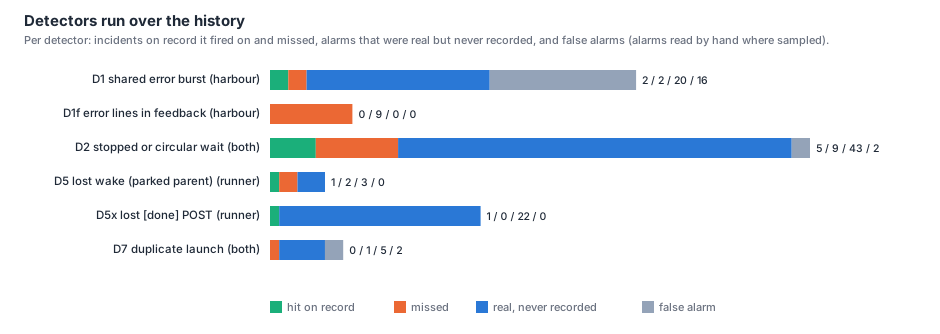
A detector over data already held catches about two in five of what is on record, hours earlier.
Six rules were written as committed scripts and run over everything their data reaches. The
calls were made by hand against each incident's text
(what-hides-between-sessions-detector-eval.json); an ambiguous alarm counts as a miss.
| Detector | Data | Rule | On record: hit / miss | Alarms nobody recorded | False alarms |
|---|---|---|---|---|---|
| D1 shared-error burst | transcripts, Sep | the same error signature in 3+ sessions within 60 min | 2 / 2 | 20 auth and transient bursts | 16, all repeated 4xx request mistakes; none if 4xx are excluded |
| D1f error lines in feedback | runner oplog, from 12 Jul | auth or outage words in 3+ sessions' feedback within 6 h | 0 / 9 | 0 | 0 |
| D2 stopped or circular wait | transcripts, Sep | every 30 min, any declared wait whose awaited chain has stopped, or a cycle | 5 / 9 | 43 | 2 |
| D5 lost wake | oplog and transcripts, Sep | parent parked, child posts terminal, no delivery within 15 min | 1 / 2 | 3 | 0 |
| D5x lost terminal post | oplog, from 12 Jul | a [done]/[failed] line whose POST failed |
1 / 0 | 22 | 0 |
| D7 duplicate launch | transcripts, Sep | same ticket and kind launched twice, overlapping | 0 / 1 | 5 | 2 |
Combined, the rules caught 9 of the 19 incidents on record that were scored in their windows (8 of 18 events: LIN-3118 and LIN-3122 are one night). D1f's window, from 12 July, holds five more credential incidents that were scored only against D1f, so counting them the rules caught 9 of 24. D5x's window also holds seven July–August lost wakes that were not scored. The two rules option A proposes, D1 and D2, caught 7 of the 19. The alarms came a median of 5.1 hours before the record's discovery, and 7 of the 9 more than 15 minutes ahead:
- LIN-3181 (dead credential): 8.8 h ahead.
- LIN-3118/3122 (the dispatcher killed overnight): 9.0 and 9.3 h ahead.
- LIN-2446 (driver wedge): 4.9 h ahead.
- LIN-2511 (a wake destroyed by the reaper): 5.1 h ahead.
- LIN-2879 (a lost
[done]post): 21 h ahead. - LIN-2473 (the Linear lane flapping): 0.8 h ahead.
At no gain were the 1 October cycle (5 minutes ahead of the Flight Companion) and LIN-2932, whose supervisor filed it within a minute of the alarm. The misses fall into five groups:
- Sessions with no transcript: opencode (LIN-2720, LIN-2876, half of LIN-2874), and launches that never started (LIN-2515).
- A single-session event: LIN-2933.
- A failure no session sees as an error: the runner silently stopped deploying merged fixes (LIN-2451), and a bootstrap re-fire never ended with nobody waiting on it (LIN-2510).
- Waits the rules do not model: in-session subagents (LIN-2559), and subtasks duplicated across different launches (LIN-2898).
- An alarm that could not be tied to the incident: LIN-2993 (D1's 503 burst came two hours after a person had filed it). The scoring file still lists that alarm as a hit, which keeps three bursts of 22–23 September out of D1's unrecorded count; called a miss throughout, D1 has 23.
D1f is the clearest negative. The runner's oplog keeps 60 characters of each feedback line, and a
session that parks on an error rarely posts it, so the rule never fired. The 8 August flood, which
three sessions each saw and parked on, was found from its tail about 22 hours after onset
(2026-08-09-proxy-401-flood.md). It left one matching line in the oplog.
The record is a fraction of what happens, though less than the alarm count says. 93 alarms are on no ticket, about 90 distinct events. The scripts call an alarm real by its class: an auth or transient error for D1, every wait class but a child still working for D2, and every alarm for D5 and D5x. On those terms the rules' false alarms are 16 of 42 for D1, 2 of 57 for D2, 2 of 7 for D7 and none for D5 and D5x. The independent check read a systematic sample of 33 of the unrecorded alarms against the transcripts and the oplog, with "real" fixed beforehand as a fault that idled a waiting session 15 minutes or more, lost or duplicated work, or needed a person or the failsafe to recover. 20 were real, 7 were errors that healed in minutes with no harm, and 6 were false. Taking out duplicates across rules, that puts the distinct real incidents at about 40 (25–50):
- D1: 20 bursts, 17
LINEAR_AUTHand 3 transient. September held 21LINEAR_AUTHbursts across three or more sessions in all, two on record (LIN-2473 and LIN-3181), the largest with 62 sessions over 7.6 hours on 24–25 September. Of 7 sampled, 6 healed within minutes with no session parked or harmed, including the 62-session burst; one was false. Whether they share LIN-3181's cause is not known from this data. - D2: 43. Mostly lost and late wakes, and five usage-limit stops. Of 11 sampled, 8 were real (2 of them usage limits) and 3 false: when a wake lands within three minutes of the waiter saying it waits, the rule folds the wake into the wait and counts a lost wake up to its 6-hour cap. Of September's 27 lost wakes, 2 were rescued by nothing at all; three more the script codes that way were woken within a minute.
- D5x: 22 failed
[done]/[failed]posts since July. The runner'ssendFeedbackdoes not retry (feedback.js:41-70). In 22 of the 23 cases the runner still wrotehook.done_posted, "the positive proof the completion propagated" (hook.js:2062-2065), because that line follows the attempt, not its success. Not every one is a lost wake: four of the 23 parents were woken anyway, some posts went again after a failsafe re-check, and four on 26 July failed because their items no longer existed. Of 7 sampled, 4 were real. - D5: 3, all real, but none a separate incident: two are LIN-2446's wedge and one is the 23 September autopilot that sat 23.7 hours. That autopilot sat because the dispatcher itself was down for about a day: the oplog is silent from 06:53Z on 23 September to 06:35Z on the 24th, and no session launched. That outage is on no ticket.
- D7: 5 true duplicates (two plan-review verdicts on LIN-3125; doubled close-outs on LIN-2667 and LIN-2718; a duplicated implementation and review on LIN-2560).
The instruments that exist are self-scoped by design. Three examples:
- Credential health is bounded to one token. Harbour's
/credential-healthread is "bounded to the token it authenticated with" and returnsunknownuntil the same failure repeats (routes/proxy-reads.js:68-104). It is a careful answer to "is my credential dead?", and by construction it cannot say "every session has seen this for an hour". - The stall failsafe runs inside the process it watches. The runner's failsafe fires after 60
minutes of silence (
config.js:50). It does real work: in September 130 of 142 re-fires were followed, at some later point, by the session working again. But because it runs inside the dispatcher, it died with the dispatcher on 26 September. - A prompt rule tells each session to absorb the error. "Don't park on one 401 … retry over
10–15 minutes" (
lib/proxy-instructions.js:1110, LIN-1938, 5 September) is the locally right behaviour. Applied in every session, it is what kept LIN-3181's 203 rejections quiet for 10 hours.
The periodicals did not find these patterns. Since June there have been 42 periodical reports from 13 of the 15 templates, 67 run tickets and 109 follow-ups.
- First finds: one, Recent Headwinds on 26 September (LIN-3104), and what it found was that the periodicals themselves had run nothing for four weeks.
- Aggregations after the fact: three grouped bugs others had already filed (LIN-896, LIN-1166, LIN-2364).
- Built in response: two invariant suites followed (LIN-1169, LIN-1490).
- A miss on record: one report missed a five-bug cluster (LIN-899).
- A gap raised and not acted on: Integration & Surface Maturity said three times (17 July,
29 August, 26 September) that Harbour has no stuck-session detection for a taken item. A
silentSinceread landed in August (LIN-2079), and nothing reads it.
This is by design. The templates read code and tracker history, never runtime logs or session
state (lib/periodicals.js:1-60). The 26 September batch cost about 109M weighted tokens, 3.1% of
September (112M with two late-August autopilots the script folds in), against under a minute of CPU
for the detectors. Their worth on the other questions they
ask is not measured here. In passing, the adversarial second read added by LIN-2323 disagreed
with 9 of the 12 reports that carry a verdict. Its own retirement condition, "near zero", was
not met.
The prompts ask for vigilance, and agents give it, one session at a time. 38 rules in served
text across both repos watch for, or handle, the patterns, about 36 KB in all
(what-hides-between-sessions-prompt-rules.json). The most text goes to stalls (9 rules,
10 KB) and lost wakes (3 rules, 7.6 KB). The earliest rule is from 6 June.
- No rule asks for a wait-cycle check. The operating manual says the mutual-wait deadlock
"doesn't apply under push" (
docs/autopilot-operating-manual.md:274, LIN-826), and the 1 October cycle is a counter-example. - What September's sessions said: they mentioned a pattern 1,479 times in 710 sessions. In a systematic sample of 40, 20 were only the words; 14 were real and the agent acted (a note to its parent or in its report, one escalation, no ticket); 6 were real and quietly retried past.
- On the record, agents found half the incidents: 54 of 107 (worker 26, supervisor 28).
- Nothing gathers what they see: seven sampled sessions reported
LINEAR_AUTHfailures between 2 and 25 September, one calling it "worth a separate look". Nothing added those reports up, and D1 would have counted 14 bursts in those days (21 in the month).
Quiet wakes are the exception that took longest to see. Each quiet wake is a no-op to the
session it enters. Only the sum is a problem. The per-beat wake landed on 16 July (LIN-1357).
The cost was first measured on 30 September (what-supervisors-do.md, then wake-inventory.md
and held-or-fresh.md), about 11 weeks later. Code can see the class of 2,295 of the 3,233
September quiet wakes before a model reads them. The other 938 cannot be told apart by class
(held-or-fresh.md v2). This is map rows 1–3, and this paper does not re-size it.
Method
Population.
- Tracker: every issue from LIN-300 onward (about 1 June), snapshotted over the workspace proxy
in 13 list pages and 110 detail reads at no more than 6 a minute (
survey-hides-tracker.mjs). - Transcripts: dispatched Claude Code sessions from 29 August to 1 October whose first turn came
before 10:14Z (2,076 sessions: 1,738 Harbour, 338 runner by the clone they edited;
survey-hides-transcripts.mjs, which has no end bound; the snapshot holds one later session). - The runner's oplog: 12 July to 1 October 10:33Z, 316k lines.
- The runner's run logs: 236 since June, with no per-line timestamps
(
survey-hides-runner.mjs). - Git: both repos.
- The periodicals' registry: read once over the proxy.
The register.
- Candidates:
survey-hides-register.mjs --candidateslists tickets with a failure word in the title and a pattern regex in the text (the regexes are in its header). - Coding: each candidate's title and first 1,500 characters were read and coded for pattern, repo, whether the instance was invisible to a single session, onset, and who found it, from the ticket's own words.
- Timing: discovery is the filing time. The fix is the first commit on main naming the ticket that touches more than docs.
Detectors.
- The rules: each is a few lines in
survey-hides-detect-sessions.mjs(D1, D2, D7) orsurvey-hides-detect-runner.mjs(D1f, D5, D5x, D8), stated in the table above and in each script's header. - Coding D2's incidents:
survey-hides-code-waits.mjsreads the transcripts after each alarm to code what each D2 incident really was: a lost wake, a late wake, a stalled child, a usage limit, a child working in the background (false) or a cycle. - Scoring:
survey-hides-analyse.mjs --nearlists every alarm from 2 hours before to 24 hours after each incident's onset (30 hours for a date-only onset). The hit or miss calls inwhat-hides-between-sessions-detector-eval.jsonwere made from that list. - Unrecorded alarms: an alarm more than an hour before or 12 hours after any hit counts as one, if its class is real.
Rates and costs.
- Rates:
survey-hides-analyse.mjstakes each pattern's September count from the instrument that measured it, else the register's count over four months. - Tokens: weighted with
survey-wake-extract.mjs's tier weights.- Retry cost is everything a session did from an error to the call that then succeeded.
- Failsafe cost is the weighted tokens of the re-fire deliveries.
- Flood cost is the deliveries inside a flood hour.
- Idle: D2's minutes from the alarm to the waiter's next activity, capped at 6 hours, and the runner's silence before each failsafe fire.
Periodicals and prompts.
survey-hides-periodicals.mjsmatches reports indocs/reviewsto templates, run tickets and follow-ups, and costs the 26 September batch from transcripts.survey-hides-prompts.mjslocates 38 rules in served text by exact anchor and dates each by its first commit.
Re-run.
- Run the transcripts, runner, wake extract (
survey-wake-extract.mjs --since 2026-08-29 --out data/survey-hides/wake, which the runner detector reads), detect, code-waits, analyse and figures scripts in order: 55 seconds of CPU, 18 of them the detectors. survey-hides-runner.mjssorts the manual run logs of July after the newest run log, so that log's fires are dated at its start: one fire counted in September came on 1 October.- The tracker, prompts and periodicals scripts are separate; the tracker and periodicals scripts call the proxy.
- Snapshots go to the git-ignored
data/survey-hides/.
Limits
- One month of transcripts. D1, D2, D5 and D7 see September only, a month with a passage layer. Wake-related rates (P5, P8) are higher than in a month without one. Rates run high for a typical month.
- No opencode transcripts. Sessions on the opencode harness leave no transcript, and launches that never start leave none either. The detectors' counts and hit rates run low by their share.
- The register is what got filed. About 40 distinct real faults the rules found are on no ticket, and so is a day-long stop of the dispatcher on 23–24 September. Record-based frequencies run low, and the record's discovery mix leans to whoever files.
- Filing time stands in for discovery. People notice before they file, and 47 of the 64 onsets are dates read as midnight. Where the onset has a time the median to discovery is 3.0 hours; where it is a date only, 19.0. Time to discovery runs high, by much of the headline's 16 hours, and the detectors' lead over discovery runs high with it.
- Hindsight. The rules were written knowing LIN-3181 and the 1 October cycle. A rule written beforehand might be tuned differently, so hit rates run high for a rule written blind. Against that, every ambiguous alarm was called a miss, which runs low. The net is unknown.
- "Real" is by class or by one reader. The scripts call an alarm real by its class. The independent check's sample found most of D1's unrecorded bursts harmless and about a quarter of D2's false, which is why about 40 of the 93 are counted real here. D2's codes, the register and the vigilance sample are one reader's. A second reader's sample of 15 register rows agreed on filing time and repo in all 15, but would recode two finders (LIN-800 and LIN-2232 were found by review, not the worker), two onsets (LIN-1113, LIN-1815), and argue five patterns and three invisibility calls.
- Costs are bounds. Retry cost counts everything between an error and the retry, so it runs high. D2's idle is capped at 6 hours, which runs low for the overnight cases, but 66 of its 108 hours are in waiters the runner had already completed, mostly after their ticket was Done, which the failsafe does not re-ask because nothing was waiting on them. As capacity lost, the 108 hours run high; 42 are in sessions still waiting.
- The periodicals' cost is one batch. Earlier batches predate the transcripts, and the 45M orchestrator that dispatched them is excluded, so it runs low. Their record is judged only on cross-session patterns. Their value on code quality and drift is not measured here, so the verdict is narrow, not low.
- The Flight Companion's record runs low. In-page chats are not readable over the proxy, so its share of discoveries runs low.
- P3 and P4 are cited, not re-measured. Their rates carry
browser-flakes.mdv2's andheld-or-fresh.mdv2's limits. P4's discovery time is an aggregate's onset to its first measurement, a different measure from a ticket's filing.
Options
Options, not changes. John decides.
| Option | Effect, with range | Evidence | Risk to correctness | How the scorecard would measure it |
|---|---|---|---|---|
| A. Run the cross-session detectors live, outside the processes they watch: D1 (shared-error burst, 4xx excluded) and D2 (stopped or circular wait), raising one alarm to a person or Flight Companion, not to every agent | Time to discovery, for the incidents it catches in P1, P2, P5 and P6b, from a median of about 15 h (3 h where the onset is timed) to about the detector's lag (0–2 h). On the record, D1 and D2 caught 7 of 19 incidents, 0–9.3 h sooner. Idle: up to the 42 h of lost-wake waiting in sessions still waiting, and the overnight freezes. Tokens: under 1% | D1 and D2 scores; the 26 September night; LIN-3181 | Low if alarms go to a decider and never act on their own. Alarm fatigue: 16 of D1's 42 alarms are 4xx request mistakes, and most of its other unrecorded bursts healed in minutes with no harm, so D1 needs a duration or harm threshold; D2 needs its three-minute merge fixed. It must not run inside the dispatcher | Median hours from onset to filing for P1–P6, before and after; idle hours per waiting supervisor; alarms per week acted on |
B. Make the runner's completion post tell the truth: retry a failed terminal post, and write hook.done_posted only on success |
Removes the D5x class: 23 failed terminal posts since July, 8 in September. Most left a waiting parent until the failsafe or a person; at least 4 were woken anyway | D5x; feedback.js:41-70; hook.js:2062-2065 |
Positive: a lost [done] is a correctness gap today |
Lost terminal posts per month (D5x) to zero |
| C. Give the periodicals the alarm log instead of asking them to find runtime faults from code | Up to 3.1% of September's tokens per batch is spent where no cross-session instance was found first. Pointing a periodical at D1 and D2's alarms makes it a reader of evidence, not a searcher | 0 first finds of P1–P8; the "no stuck-session detection" gap flagged three times | Low for this class; their code-quality findings are untouched | Periodical findings that name a runtime incident; their cost per batch |
| D. Retire vigilance text where a detector takes over (inside the anchor's row 11) | A few KB of the 36 KB of rule text, and the turns agents spend noticing alone. Small in tokens | 38 rules; 14 of 40 sampled mentions acted, none gathered | Medium: Rasmussen's warning, since a defence's worth is invisible until removed. Retire only after A has run a month | Rule bytes per pattern; the discovery time of each pattern stays flat or falls |
| E. An alarm for duplicate launches (D7) | 0.15% of tokens, 5 pairs a month | D7 | Low | Duplicate pairs per month |
Option A is the principle "code detects, the model decides" at its smallest. It changes no supervisor's role and keeps every altitude. In tokens it does not overlap map rows 1–3, which route quiet wakes; it watches what goes wrong between them. In mechanism it overlaps row 3, which moves the liveness clocks into the runner and dispatch code, and option B is wake-delivery plumbing of the kind row 1's safety check names; built separately they would watch the same waits twice. In correct work per budget it is worth little directly, a percent or two of tokens. What it buys is latency and the overnight capacity that a silent failure loses: hours per correct change, not tokens.
Next
- What were September's 19 other
LINEAR_AUTHbursts across three or more sessions? Were they LIN-3181's dead credential re-selected earlier, or other faults? Join D1's episodes to the server's credential-selection log, now retained (LIN-3157). - If D1 and D2 ran live for four weeks and alarmed to a Flight Companion, how many alarms would it act on? And does the median time from onset to discovery fall from about 16 hours (3 where the onset is timed)?
- Sibling papers this wave:
prototype-concepts.md(John's concepts, with Lighthouse as a comparator) andreplay-small-work.md(the pre-registered replay). This paper does not overlap either.